

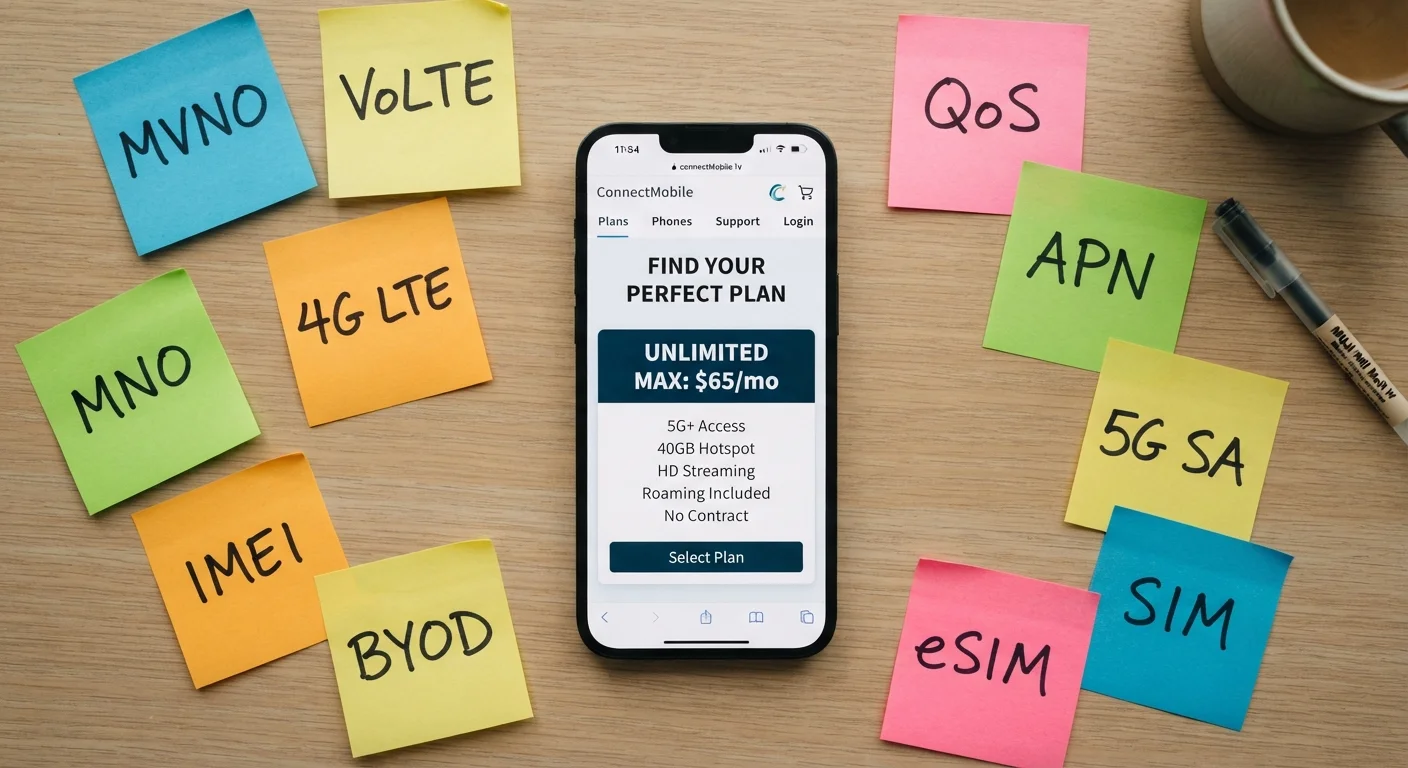
Why Carrier Jargon Matters
Wireless carrier plan pages are engineered for persuasion, not clarity. Acronyms, asterisks, and undefined speed thresholds fill every panel. Understanding these terms before you sign a contract isn't just a nice-to-have - it directly affects what you pay and how reliably your service works day to day.
This reference covers the most common terms you'll encounter. Bookmark it before reading a wireless plan in detail, where each of these concepts shows up in real contract language.
Network and Speed Terms
Most confusion on carrier plan pages centers on network technology labels and speed claims. Here are the critical distinctions:
- 4G LTE vs. 5G: LTE remains the backbone of U.S. wireless coverage. 5G is an overlay - your phone will use 5G where available and fall back to LTE elsewhere. Advertised "5G" coverage can mean very different things depending on which frequency band is in use.
- Sub-6 GHz vs. mmWave 5G: Sub-6 GHz 5G behaves similarly to LTE in terms of range but offers meaningfully faster typical speeds. mmWave delivers headline-grabbing peak speeds but only within a short distance of a transmitter, primarily in stadiums, airports, and dense downtowns.
- Download vs. upload speeds: Carriers almost always advertise download speeds. Upload speed - critical for video calls, cloud backups, and sending files - is usually a fraction of the download figure and rarely prominently disclosed.
For a side-by-side breakdown of speed units themselves, the Mbps, Gbps, and latency glossary explains what those numbers actually mean in practice.
Plan Structure Terms
The structure of a plan determines your real-world experience more than the advertised network generation does.
Throttling vs. deprioritization is one of the most misunderstood distinctions. Throttling is predictable: once you hit a data threshold, speeds drop for the rest of the billing cycle regardless of network conditions. Deprioritization is conditional: your speed drops only when the tower you're connected to is congested, and recovers once load eases. Both appear on plan pages, often interchangeably, so read the terms carefully.
Hotspot data is a separate bucket from your smartphone data on most plans. A plan might offer 15 GB of hotspot data and "unlimited" smartphone data - but only one of those figures applies when your laptop connects through your phone.
MVNOs Use the Same Physical Towers
When a carrier plan page says a service runs on a major network, that claim can be accurate even for smaller brands. MVNOs lease access to existing tower infrastructure, so the underlying radio coverage may be identical to the parent carrier. The differences typically show up in customer service, international features, and how traffic is prioritized during congestion. For a deeper look at how this arrangement works, see how MVNOs work.
Device and SIM Terms
Understanding how your device connects to a network prevents costly mistakes when switching carriers or buying a new phone.
Unlocked vs. locked phones: A locked phone is configured to work only on the carrier that sold it. Carriers are required by FCC policy to unlock devices after contractual obligations are met, but the process and timing vary. An unlocked phone can be moved between compatible networks freely.
eSIM and physical SIM: Many current smartphones support both. The practical advantage of eSIM is the ability to hold multiple carrier profiles and switch without a physical card - useful for travel or testing a new carrier. Learn more about the wireless technologies built into your phone in our guide to phone wireless standards.
BYOD compatibility: Not every unlocked phone supports every carrier's frequency bands. Before bringing your own device, verify that it supports the target carrier's key bands - particularly for 5G - using the carrier's compatibility checker or the phone manufacturer's band specifications.
For calls specifically, knowing whether your phone and plan support VoLTE or Wi-Fi calling affects call quality in low-signal areas. See how Wi-Fi calling and VoLTE work for a full breakdown.