
Risk Tolerance Explained: What It Is and Why It Shapes Every Investment Decision

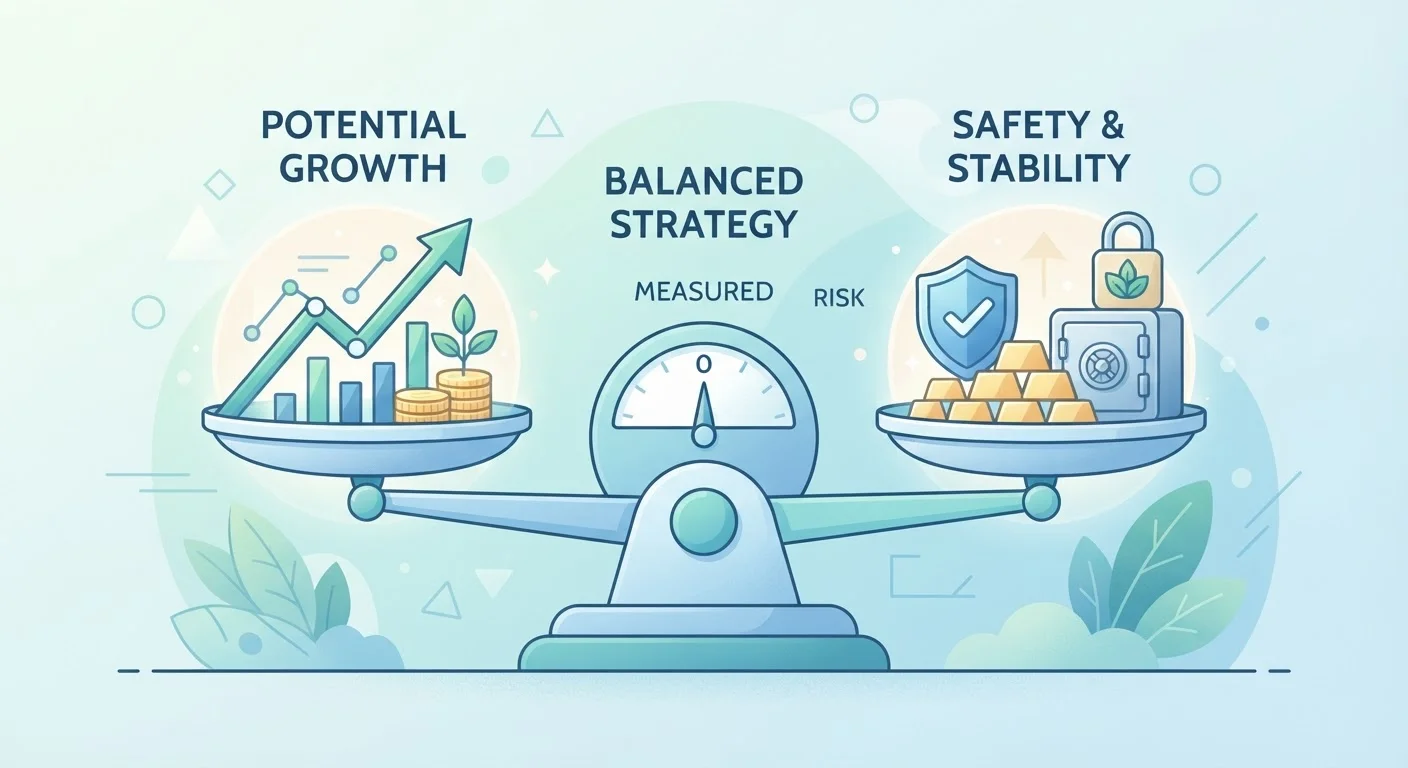
Key Takeaways
- Risk tolerance measures both your emotional comfort with loss and your financial ability to absorb it.
- It is not fixed - your risk tolerance changes as your income, goals, and life stage evolve.
- Misaligning your portfolio with your risk tolerance can lead to panic selling or under-investing.
- Higher potential returns almost always come with higher potential for loss.
- A financial adviser can help you assess your true risk tolerance and build a portfolio accordingly.
Risk Tolerance
Risk tolerance is the degree of uncertainty - including the possibility of losing money - that an investor is willing and able to accept in pursuit of financial growth. It reflects both your emotional comfort with market ups and downs and your actual financial capacity to absorb losses. Everyone's risk tolerance is different, and it shapes which investment options are appropriate for your situation.
Financial professionals often distinguish between 'risk capacity' (what you can afford to lose given your financial situation) and 'risk attitude' (your psychological comfort with volatility). A well-matched portfolio accounts for both dimensions.
What Risk Tolerance Actually Measures
When financial professionals talk about risk tolerance, they're asking a deceptively simple question: how much can you handle losing - without panicking and making decisions that hurt your long-term goals?
The answer has two parts. The first is psychological: how do market swings make you feel? If a 15% drop in your portfolio value would keep you up at night or prompt you to sell everything, your emotional comfort with volatility is relatively low. The second part is financial: even if you're emotionally calm, can your actual circumstances absorb a loss? Someone with three months of expenses in savings and a mortgage due next year has very different financial capacity than someone with stable income and no near-term cash needs.
Both dimensions matter. A mismatch between what you feel you can handle and what your finances actually allow is one of the most common sources of costly investment mistakes. Before exploring what investing really means, it helps to know where you honestly stand on this spectrum.
Risk Tolerance Is Not a One-Time Assessment
Many brokerage and retirement platforms offer questionnaires designed to gauge your risk tolerance. These are useful starting points, but they're not permanent diagnoses. Revisiting your risk profile after major life events - a job change, marriage, divorce, a new child, or an inheritance - helps ensure your portfolio continues to reflect your actual situation. A licensed financial adviser can guide this reassessment.
The Risk-Return Trade-Off: Why It Matters
A foundational principle in investing is that higher potential returns come with higher potential risk. This isn't a coincidence - it's how markets function. Investors demand greater reward for taking on greater uncertainty.
Consider two broad categories. Government bonds issued by stable economies are considered lower-risk investments; they tend to offer modest, relatively predictable returns. Stocks in individual companies carry more volatility - their value can rise dramatically or fall sharply - but historically, equities have offered higher long-term growth potential than lower-risk alternatives. Neither is universally better. What matters is which aligns with your situation.
This trade-off directly informs what belongs in your portfolio. Stocks, bonds, and funds each carry different risk profiles, and understanding those differences is central to building a strategy that fits your tolerance.
~60%
Americans who report investing anxiety during market downturns
Survey data from financial research organizations consistently finds that a majority of retail investors feel significant stress during periods of notable market decline, often leading to reactive decision-making.
3-5x
Potential long-term return gap between aggressive and conservative portfolios
Historical modeling by financial researchers suggests that over multi-decade horizons, portfolios weighted toward equities have often substantially outperformed conservative allocations - but with significantly higher volatility along the way.
20%
Portfolio loss that causes many investors to reconsider their strategy
Financial planners frequently use a hypothetical 20% loss scenario as a practical stress test because research suggests this level of decline is a common threshold where investors' stated and actual comfort levels diverge.
How Risk Tolerance Shifts Over Time
Risk tolerance is not a fixed trait. Life changes - and so does the appropriate level of risk in your investment approach.
Early in your career, time is one of your greatest financial assets. A market downturn at age 28 is painful on paper, but a long time horizon gives your portfolio room to recover before you need the money. Many investors in this stage can reasonably consider a portfolio weighted toward growth-oriented assets.
As you approach retirement or major financial milestones - a home purchase, funding education, a career transition - the calculus shifts. Losses you once had decades to recover from now carry more immediate consequence. Most financial planning frameworks recommend gradually adjusting toward more conservative allocations as these milestones near.
Life circumstances play a role too. Job security, income stability, dependents, debt levels, and emergency savings all affect your real capacity for risk. Debt obligations across life stages can significantly constrain how much financial risk is sensible to carry at any given time.
Putting Risk Tolerance Into Practice
Understanding your risk tolerance in the abstract is one thing; translating it into investment decisions is another. In practice, your risk tolerance should guide your asset allocation - the mix of different investment types in your portfolio.
A conservative investor might hold a higher proportion of bonds and stable, income-generating assets, accepting lower growth in exchange for reduced volatility. A moderate investor might balance growth-oriented and more stable assets. An aggressive investor might skew heavily toward equities and growth assets, accepting wider swings in exchange for higher long-term potential.
It's worth being honest with yourself about the difference between how you think you'd react to a market drop and how you actually would. Many investors overestimate their tolerance in a rising market and discover their real comfort level only when losses materialize. This is a well-documented phenomenon - and one reason why working with a qualified financial adviser to assess your risk profile can be genuinely valuable.
For those building foundational knowledge, reviewing essential investing terms - like asset allocation, diversification, and rebalancing - helps make these concepts more actionable. If you're considering individual equities, understanding the trade-offs of individual stocks is a useful next step.
Test Your Tolerance Before the Market Does
Before committing to an investment strategy, honestly ask yourself: if my portfolio lost 20% of its value this year, what would I do? If your first instinct is to sell, your risk tolerance may be lower than you think. Matching your portfolio to your real comfort level - not an idealized version of it - helps prevent panic-driven decisions that can lock in losses.
This article is for general informational and educational purposes only and does not constitute personalized financial, investment, or legal advice. Consult a qualified, licensed financial professional before making decisions based on your individual circumstances.