

| Topic category | Investing basics / financial literacy |
| Terms covered | 12 core investing concepts |
| Audience | Beginners with no financial background |
| Content type | General education - not personalized financial advice |
Why Learning the Language of Investing Matters
Starting to invest can feel intimidating - not because the concepts are impossibly complex, but because the vocabulary is unfamiliar. Terms like expense ratio, yield, and rebalancing can make a straightforward decision feel like decoding a foreign language.
The good news: you don't need an economics degree to understand investing. You need a reliable reference. This glossary covers the words and phrases you'll encounter most often as a beginner, explained in plain English. If you're still deciding whether investing is right for you at all, it's also worth reading common investing myths debunked before going further.
| Topic category | Investing basics / financial literacy |
| Terms covered | 12 core investing concepts |
| Audience | Beginners with no financial background |
| Content type | General education - not personalized financial advice |
Core Investing Terms Defined
The terms below form the backbone of most beginner investing conversations. Understanding them will help you read brokerage account summaries, evaluate fund options, and follow financial news with more confidence.
Portfolio
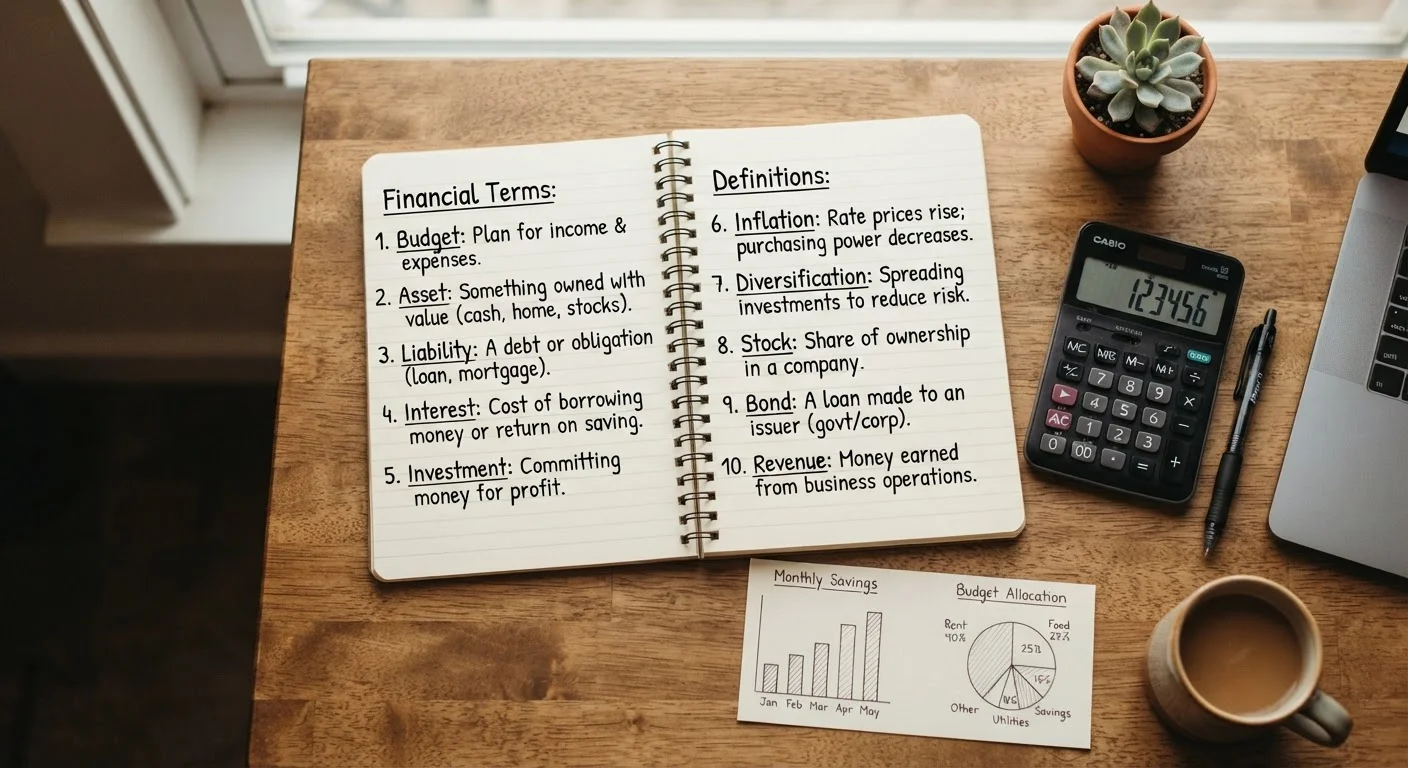
The total collection of investments you own - stocks, bonds, funds, or other assets - held across one or more accounts. Think of it as the complete picture of what you've invested in.
Asset
Anything of economic value that you own or control. In investing, common assets include stocks, bonds, real estate, and cash equivalents.
Stock (Equity)
A share of ownership in a company. When you buy stock, you become a part-owner of that business and may benefit if it grows - but also share in its losses.
Bond
A loan you make to a company or government in exchange for regular interest payments and the return of the original amount at a set date. Bonds are generally considered lower risk than stocks, but typically offer lower potential returns.
Index Fund
A type of fund designed to mirror the performance of a specific market index, such as the S&P 500. Because they don't rely on active management, they typically carry lower fees.
Expense Ratio
The annual fee a fund charges investors, expressed as a percentage of assets. For example, a 0.10% expense ratio means you pay $1 per year for every $1,000 invested. Lower expense ratios mean more of your returns stay with you.
Diversification
Spreading investments across different assets, sectors, or geographies to reduce the impact of any single investment performing poorly. The principle is that losses in one area may be offset by gains in another.
Yield
The income generated by an investment, expressed as a percentage of its price. A bond paying $50 annually on a $1,000 investment has a 5% yield. Yield does not account for changes in the investment's price.
Rebalancing
The process of adjusting your portfolio back to its intended mix of assets after market movements shift the proportions. For example, if stocks outperform and now make up more of your portfolio than planned, you might sell some stocks and buy bonds to restore balance.
Risk Tolerance
Your personal capacity and willingness to absorb investment losses in exchange for the possibility of higher returns. Risk tolerance is shaped by factors like your time horizon, income, financial goals, and comfort with uncertainty.
Compound Growth
Growth that builds on previous growth. When investment returns are reinvested, they generate their own returns over time. Over long periods, this effect can significantly increase the value of an investment.
Liquidity
How quickly and easily an investment can be converted to cash without significantly affecting its price. Stocks traded on major exchanges are generally highly liquid; real estate or private investments are much less so.
For a deeper look at how these assets actually work together in practice, see Stocks, Bonds, and Funds: The Building Blocks of Most Portfolios.
This article is for general informational and educational purposes only. It is not personalized financial, investment, tax, or legal advice. Investing involves risk, including the possible loss of principal. Consult a qualified financial adviser before making decisions about your own financial situation.
Putting It All Together
Knowing the vocabulary is just the start. Once these terms feel familiar, you'll be better equipped to read fund prospectuses, understand your account statements, and have more informed conversations with a financial professional.
If you're ready to take the next step, Investing From Scratch walks through account types, asset classes, and risk in practical terms built for complete beginners. And if you want to ensure your investing goals connect to a solid everyday money foundation, explore the Budgeting & Saving hub for strategies to manage spending and build savings alongside your investments.
These Terms Are a Starting Point
Investing terminology evolves, and some terms - like 'yield' or 'risk' - carry slightly different meanings depending on the context. When reading fund documents or account statements, look for the specific definition provided. For decisions about your own money, a licensed financial adviser can help translate terms into choices suited to your situation.