

Key Takeaways
- Debt priorities shift significantly from education and credit-building in early adulthood to mortgage management and retirement readiness in later years.
- Risk tolerance and time horizon - not just income - should guide how aggressively you repay or carry debt at each stage.
- Entering retirement with significant high-interest debt can meaningfully reduce financial security on a fixed income.
- Life events like marriage, job changes, and children often reset your debt strategy entirely.
- A qualified financial professional can help tailor a debt approach suited to your specific stage and circumstances.
Why Your Life Stage Shapes Every Borrowing Decision
Debt is not a single problem to be solved once. It's a moving target that changes shape as your income grows, your family evolves, and your retirement horizon shortens. What counts as reasonable debt at 24 - a student loan at a manageable interest rate - may represent real risk at 64, when you're drawing down savings instead of accumulating them.
Understanding how borrowing priorities, repayment strategies, and risk tolerance evolve across life stages gives you a framework for making smarter decisions - not just today, but over the long arc of your financial life. This article walks through the key shifts that tend to happen, and why they matter. As always, the specifics of any debt strategy depend on your individual circumstances; consider consulting a licensed financial adviser before making major decisions.
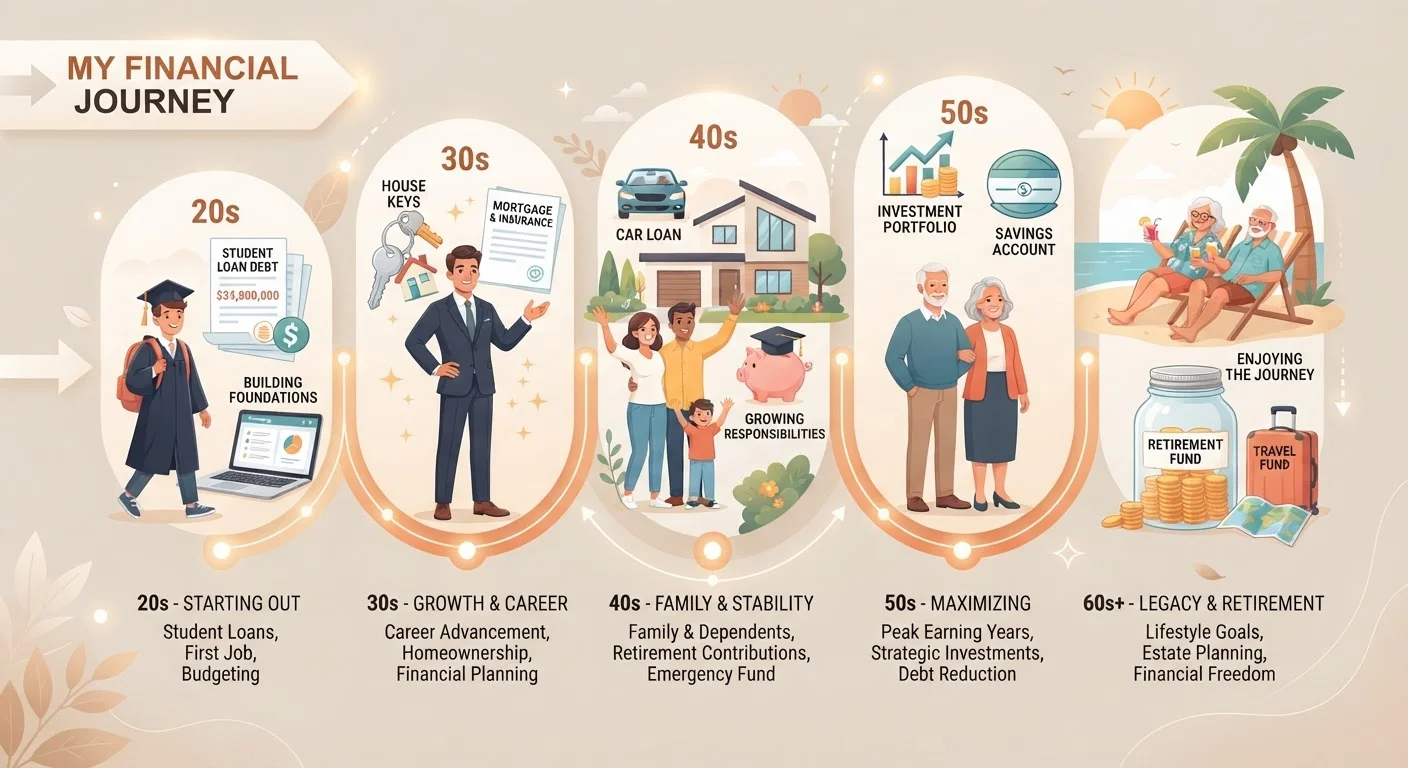
Early Adulthood (Roughly Ages 18-29): Building Credit While Managing Education Debt
For many Americans, debt begins with student loans - often taken on before they fully understand interest compounding or repayment structures. Early adulthood is a critical window for establishing creditworthiness while avoiding high-cost borrowing habits that can follow you for years.
The central tension here is between building a credit profile and managing cash flow on an entry-level income. Prioritize paying at least the minimum on all obligations to protect your credit score, and be cautious about revolving credit card balances, which typically carry much higher interest rates than federal student loans. Small, consistent behaviors - on-time payments, low credit utilization - do more for your long-term financial health than almost any other tactic at this stage. See how everyday habits affect your score in our article on habits that quietly drag down a good credit score.
On-time payments and low credit utilization do more at this stage than almost any other tactic.
Young Professional Years (Roughly Ages 30-39): Mortgage Debt and Competing Priorities
By the thirties, income typically rises - but so do financial obligations. Mortgages, childcare costs, and the need to build emergency savings all compete with debt repayment. This is the stage where debt type matters enormously.
A fixed-rate mortgage on a home you plan to stay in is fundamentally different from a high-interest personal loan or revolving credit card debt. The former builds equity over time; the latter erodes it. If you're evaluating mortgage structures, understanding the difference between fixed and adjustable rates is essential - our explainer on fixed-rate vs. adjustable-rate mortgages covers the tradeoffs in depth. At this stage, directing extra cash toward high-interest debt before low-interest mortgage debt is usually the more cost-effective approach.
Debt type matters enormously in your thirties - not all borrowing carries the same financial weight.
Peak Earning Years (Roughly Ages 40-54): Accelerating Paydown and Protecting Future Flexibility
The forties and early fifties often bring higher income - and with it, real opportunity to reduce debt aggressively before retirement comes into view. This is also when some people face new debt pressures: college tuition for children, aging-parent support, or business investment.
A useful benchmark during this period is to avoid taking on any debt whose repayment would extend into retirement. If you're considering consolidating multiple obligations to simplify repayment and lower rates, that can be a reasonable tool - but it comes with tradeoffs worth understanding. Our article on debt consolidation: what it changes and what it doesn't explains what consolidation actually accomplishes and when it makes sense.
Avoid taking on debt whose repayment would extend into your retirement years.
Pre-Retirement (Roughly Ages 55-64): Reducing Exposure Before Income Shifts
As retirement approaches, risk tolerance typically decreases - and that applies directly to debt. Fixed incomes leave less room to absorb unexpected interest costs or missed payments. This stage calls for a deliberate review of what you owe and a realistic plan to eliminate or significantly reduce it before you stop working.
High-interest debt - credit cards, personal loans, any remaining auto loans - should be prioritized for payoff. If a mortgage remains, evaluate whether accelerated payments are feasible. It's also worth understanding how risk tolerance shapes financial decisions at this stage, since the balance between paying down debt and maintaining liquid assets becomes a genuine strategic question.
Carrying high-interest debt into a fixed-income retirement is one of the most avoidable financial risks.
Retirement (Ages 65 and Beyond): When Debt Becomes a Fixed-Income Problem
In retirement, most people shift from earning income to drawing it down from savings, Social Security, and pensions. Debt that was manageable on a working income may strain a retirement budget significantly. A mortgage payment that represented 20% of monthly income at 50 might represent 35% of a reduced retirement income at 70.
If debt does persist into retirement, it's especially important to avoid actions that can damage your credit or accelerate financial erosion - such as allowing accounts to go delinquent. Understanding what happens when debt goes unpaid, including what changes after a debt goes to collections, is useful context. The overarching goal at this stage is financial stability and predictability - minimizing obligations that add variability to a fixed-income situation.
Debt that was manageable at 50 can strain a retirement budget significantly by 70.
Applying This Framework to Your Situation
Life stages are rarely neat. Career pivots, divorce, caregiving responsibilities, or variable income can mean your debt profile doesn't match a tidy age bracket. If your income fluctuates, see our guide to managing debt with unpredictable income for strategies built around that reality.
Across every stage, a few principles hold: keep high-interest debt short-lived, protect your credit by paying on time, and revisit your debt load whenever your income or life circumstances change significantly. The Budgeting & Saving hub offers practical tools to support that ongoing review. And if you're thinking about channeling freed-up cash flow toward growth once debts are under control, the Investing Basics hub is a useful next step.
Revisit Your Debt Strategy at Every Major Life Event
Marriage, divorce, a new child, a job change, or an inheritance can each fundamentally alter your debt capacity and priorities. Rather than reviewing your debt approach on a fixed schedule, treat major life transitions as automatic triggers for reassessment. A few hours with your financial picture - and ideally a licensed adviser - can prevent years of misaligned strategy.
This article is for general informational and educational purposes only and does not constitute personalized financial, tax, or legal advice. Consult a qualified financial professional regarding your specific situation.