

Key Takeaways
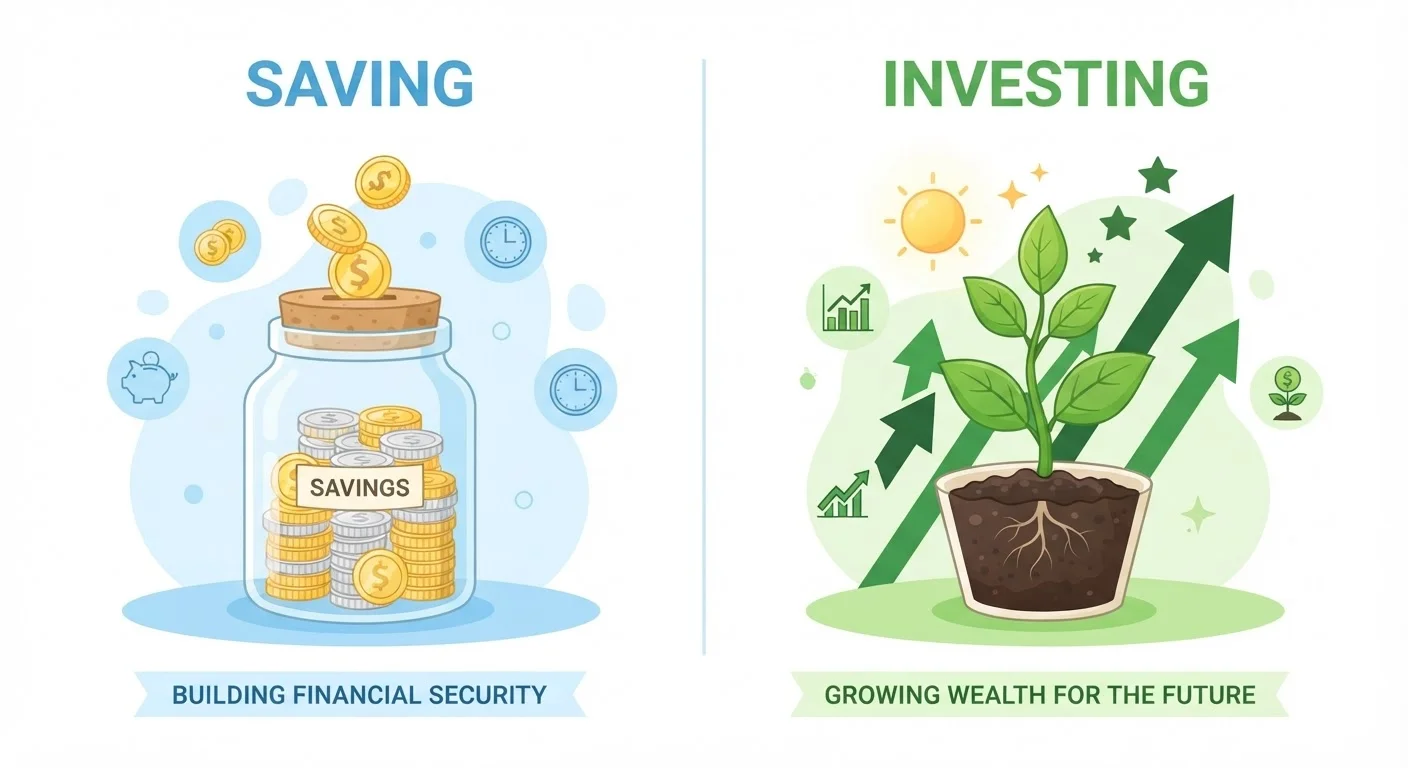
- Saving prioritizes security and accessibility; investing prioritizes long-term growth.
- Investing carries risk - the value of your money can go down as well as up.
- Time in the market is a key advantage; starting earlier generally allows more growth potential.
- Both saving and investing serve distinct roles and most people benefit from having both.
- You don't need to be wealthy to start investing, but you should have a financial foundation first.
Investing
Investing means putting your money to work with the expectation that it will grow in value over time. Unlike saving - where your money sits in a secure account earning modest interest - investing involves committing money to assets such as stocks, bonds, or funds that carry some level of risk in exchange for the potential of higher returns. The goal is to build wealth over the long term, not to keep funds readily accessible for near-term expenses.
In financial terms, investing involves deploying capital into assets expected to generate income, appreciation, or both. Returns are not guaranteed, and the value of investments can fall as well as rise.
Saving and Investing: Similar Words, Very Different Jobs
Most people use the words "saving" and "investing" interchangeably. In everyday conversation, that's understandable - both involve setting money aside rather than spending it. But in personal finance, they serve fundamentally different purposes, and confusing them can leave you financially underprepared.
Saving means storing money somewhere safe and accessible - typically a checking or savings account - so it's there when you need it. The priority is stability: your $500 today is still $500 tomorrow, plus a small amount of interest. You might save for an emergency fund, a vacation, or a large purchase coming up in the next year or two. For a closer look at how savings fits into your financial picture, see our guide to savings rates.
Investing means putting money into assets - such as stocks, bonds, or funds - with the expectation that they'll grow in value over time. The trade-off for that growth potential is risk: unlike a savings account, the value of investments can fall. That's not a flaw in the system; it's the nature of the exchange.
Savings Accounts Are Insured; Investments Are Not
Money held in savings accounts at FDIC-insured banks is protected up to $250,000 per depositor, per institution. Investment accounts do not carry this protection - market losses are real and possible. Understanding this distinction is essential before deciding where to put your money.
Why Risk Is Part of the Equation
The concept of risk stops many people from ever starting to invest. But risk in investing doesn't mean "you'll probably lose your money." It means the outcome isn't guaranteed - and the level of risk varies enormously depending on the type of investment.
Historically, markets have trended upward over long time periods, though past performance does not guarantee future results. The key factor that helps manage risk is time. An investment that drops in value this year has the opportunity to recover and grow if left in place for a decade. This is why investing is generally considered a long-term strategy - not something you do with money you'll need next month.
If you're curious about common fears around investing that hold people back, our piece on investing myths addresses many of them directly.
~56%
American adults who own stocks
According to Gallup polling, roughly 56% of U.S. adults report owning stocks, either directly or through funds and retirement accounts.
3-5%
Typical high-yield savings APY range
High-yield savings account rates fluctuate with Federal Reserve policy; even at their highest, they rarely match long-term average stock market returns historically.
~10%
Average annual S&P 500 return (historical)
The S&P 500 has averaged roughly 10% annually before inflation over long historical periods - though past performance does not guarantee future results and returns vary significantly year to year.
How Investing Actually Works
When you invest, you're essentially buying an ownership stake or lending money to an entity - a company, a government, or a group of assets - in exchange for a share of future returns. Those returns can come from two sources:
- Appreciation: The asset rises in value over time. A stock you buy for $50 may be worth $80 in five years.
- Income: Some assets pay regular dividends or interest, providing returns even if the price hasn't changed significantly.
One of the most powerful forces in investing is compounding - when your returns generate their own returns. Over long periods, this can turn modest, consistent contributions into substantial sums. It's also why starting earlier tends to carry a significant advantage over waiting until you have "more" money to invest.
Spreading your investments across different types of assets is another core principle. Our explainer on diversification covers why this matters and how it works in practice.
Do You Need Both Saving and Investing?
For most people, yes - and for different reasons. Saving handles your near-term needs: the car repair, the medical bill, the job loss. Investing handles your long-term future: retirement, financial independence, generational wealth. Relying only on savings means your money grows slowly and may not outpace inflation over time. Relying only on investments means you may be forced to sell at a bad time if an unexpected expense arises.
A common framework: build a solid savings foundation first - including an emergency fund covering several months of essential expenses - before committing money to investments. Once that's in place, investing can run alongside saving, each working toward its own distinct goal.
This article is for general informational purposes only and does not constitute personalized financial, investment, tax, or legal advice. Please consult a qualified financial professional before making decisions about your own financial situation.
When you're ready to take the next step, our beginner's guide to investing walks through accounts, asset types, and how to get started with no prior experience.