

Key Takeaways
- Installment loans and revolving credit affect your credit score through different scoring mechanisms.
- Credit mix - having both types - is a recognized factor in most major credit scoring models.
- Revolving credit utilization ratio has an outsized effect on your score compared to installment balances.
- Lenders review both account types to assess repayment reliability and debt management behavior.
- Neither credit type is inherently superior; the right balance depends on your financial goals.
Our Verdict
Installment loans demonstrate your ability to manage fixed, long-term obligations consistently, while revolving credit shows how you handle flexible borrowing and restraint. A credit profile that includes both tends to signal financial maturity to lenders, but revolving credit demands more active management due to its impact on utilization. Neither type alone tells your full story - together, they build a more complete and credible borrowing history.
| Best for | Recommended |
|---|---|
| Those building a long-term credit history with predictable payments | Installment Loans |
| Those seeking flexible access to credit with low balances | Revolving Credit |
| Those aiming for a well-rounded, lender-ready credit profile | Both Types Combined |
The Structural Difference Between the Two Credit Types
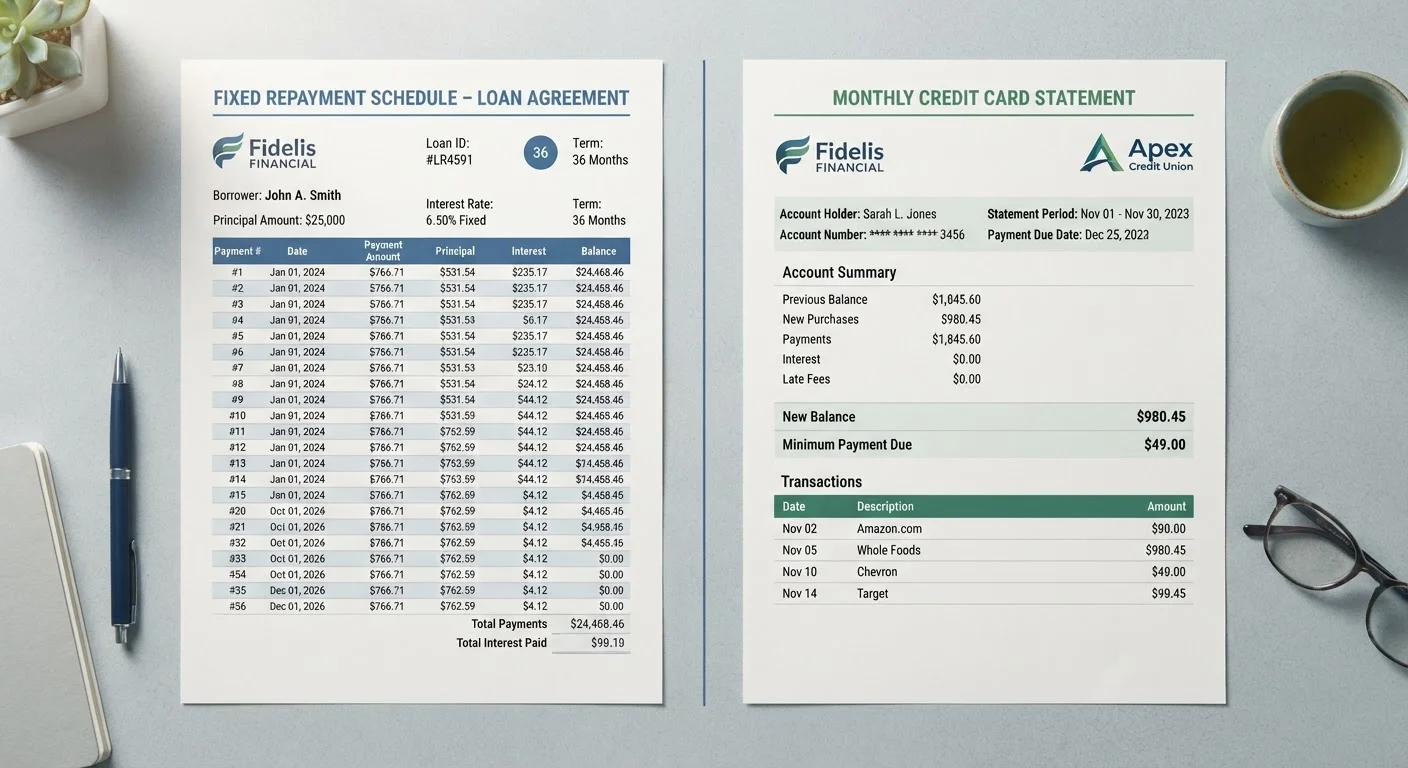
At their core, installment loans and revolving credit are built on fundamentally different borrowing frameworks - and those structural differences determine how each one is treated by scoring models and lenders alike.
An installment loan provides a fixed sum of money upfront that you repay over a set term in regular, equal payments. Auto loans, personal loans, student loans, and mortgages are all installment products. The repayment schedule is predetermined; once you've borrowed, the balance only decreases. For a deeper look at how a major installment loan works in practice, see our guide to fixed-rate vs. adjustable-rate mortgages.
Revolving credit, by contrast, gives you access to a reusable credit limit. Credit cards and home equity lines of credit (HELOCs) are the most common examples. You can borrow, repay, and borrow again - up to your limit - and your required minimum payment fluctuates with your balance. This open-ended structure means the account stays active indefinitely as long as it remains in good standing.
These aren't just product differences; they represent two distinct lending relationships with different risk profiles from a creditor's perspective.
How Each Type Influences Your Credit Score
Credit scoring models - including the widely used FICO® Score - evaluate installment and revolving accounts differently within their calculations.
| Installment Loans | Revolving Credit | |
|---|---|---|
| Structure | Fixed amount, fixed term | Reusable credit limit |
| Common Examples | Mortgage, auto loan, personal loan | Credit card, HELOC |
| Payment Amount | Fixed, predetermined | Variable, based on balance |
| Primary Score Impact | Payment history | Utilization ratio |
| Balance Movement | Only decreases over time | Can increase and decrease |
| Account Lifespan | Closes when paid off | Remains open indefinitely |
| Lender Signal | Long-term commitment management | Discretionary borrowing restraint |
Revolving credit carries particular weight through the utilization ratio - the percentage of your available revolving credit that you're currently using. This figure, sometimes called the credit utilization rate, is one of the most influential variables in your score. Carrying high balances on revolving accounts relative to your limits can drag your score down significantly, even if you pay on time. For a detailed breakdown of how this works, our article on credit utilization covers the mechanics and common misconceptions.
Installment loan balances, by contrast, are weighted differently. Scoring models do consider how much of the original loan balance remains, but it's generally less sensitive than revolving utilization. What matters more with installment debt is consistent, on-time payment history - which feeds directly into the payment history category, the single largest component of most credit scores.
Credit mix - whether your file contains both installment and revolving accounts - is also a recognized scoring factor. A profile with only one type may score somewhat lower than a comparable profile with both, all else being equal.
What Lenders Actually See When They Review Your File
Beyond automated scoring, lenders who manually review applications look at both credit types through a specific lens: can this borrower handle different kinds of financial commitments?
Installment loans signal disciplined, long-term repayment behavior. A mortgage paid reliably over many years, or an auto loan satisfied without missed payments, demonstrates that you can manage a structured obligation. This matters especially when you're applying for another installment product - a lender offering a personal loan, for example, wants to see that you've handled similar structures before.
Revolving accounts tell lenders something different: how you behave when you have discretion over how much to borrow. A borrower who consistently keeps revolving balances low - well under their available limits - signals self-restraint and liquidity awareness. One who routinely maxes out cards may be seen as over-reliant on credit, regardless of payment history.
Keep Revolving Balances Low, Not Zero
Having a small, regularly paid revolving balance can confirm active account use to scoring models, while keeping utilization well below your limit. Completely unused cards may eventually be closed by the issuer for inactivity, which can affect your available credit. Modest, consistent use followed by on-time payment tends to serve your profile better than leaving accounts dormant.
If you're earlier in your credit journey, understanding which account types to open first can make a meaningful difference. Our article on building credit from zero walks through the practical options. And for a focused comparison of two popular credit-building tools, see our piece on secured cards vs. credit-builder loans.
Opening either type of account also triggers a hard inquiry on your credit report, which can have a temporary score impact. Our explainer on hard vs. soft inquiries clarifies exactly what that means and how long it lasts.
Practical Implications for Managing Both Account Types
Knowing how lenders and scoring models interpret these accounts points toward a few clear management principles.
For revolving credit, keeping utilization consistently low - a commonly cited guideline is below 30%, though lower tends to be better - is one of the most direct levers you have for score improvement. Paying balances in full each month avoids interest entirely and keeps utilization low. Because utilization can shift month to month, it's one of the more dynamic parts of your score.
For installment loans, the primary value is in never missing a payment. Autopay and calendar reminders help ensure that the steady positive history these accounts build isn't interrupted by an oversight. Paying off an installment loan, while financially beneficial, can sometimes cause a modest temporary dip in your score if it reduces your credit mix or lowers your average account age - this is normal and typically resolves over time.
Borrowers managing multiple debts across both types may benefit from a structured repayment approach. Our comparison of debt avalanche vs. debt snowball strategies offers a framework for prioritizing payoff efficiently. As financial responsibilities grow and shift, how debt management changes across life stages is also worth considering.
This article provides general financial education and is not personalized financial or credit advice. Consult a qualified financial adviser or credit counselor for guidance specific to your situation.