

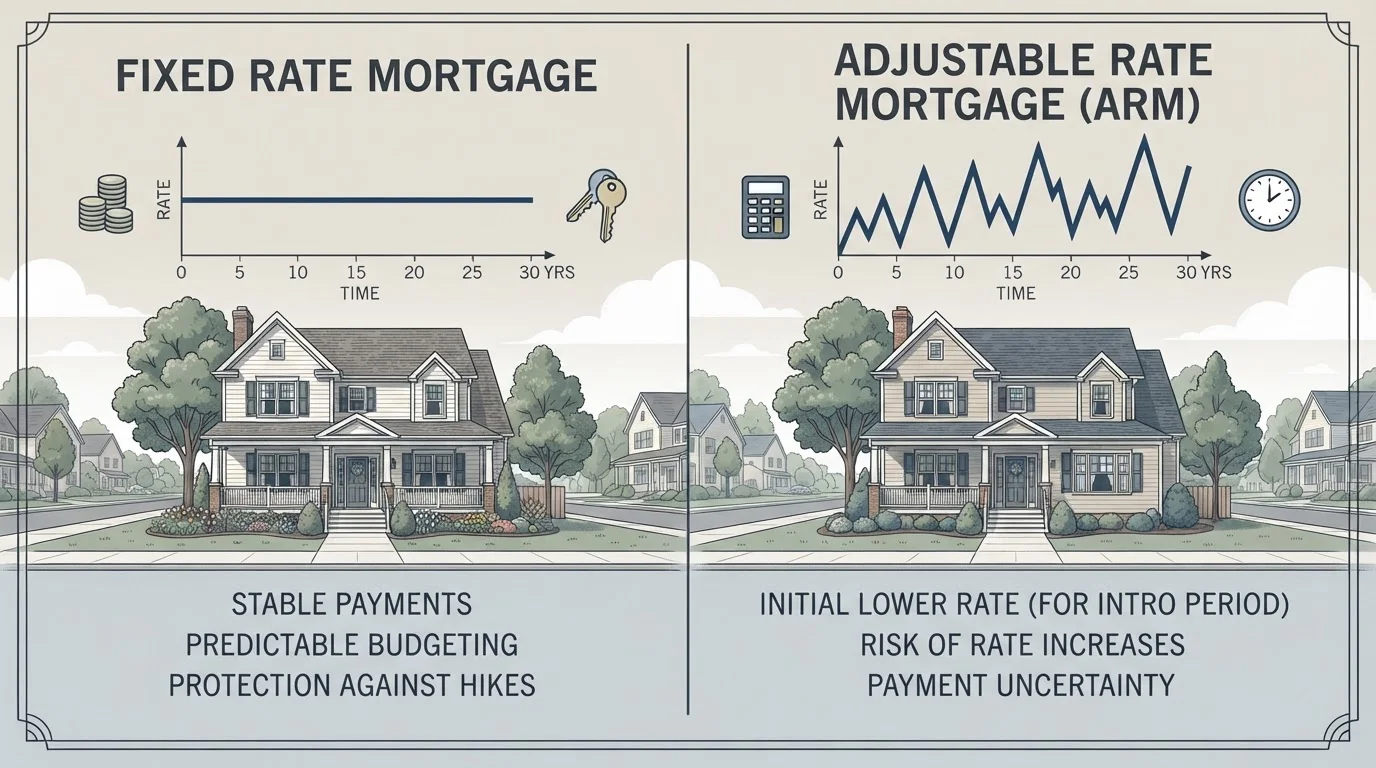
Key Takeaways
- Fixed-rate mortgages lock in your interest rate for the entire loan term, keeping monthly payments stable.
- Adjustable-rate mortgages start with a fixed introductory rate, then adjust periodically based on a market index.
- ARMs typically offer lower initial rates than FRMs, but carry the risk of payment increases over time.
- Your timeline for owning the home is often the most important factor in choosing between these structures.
- Both loan types have caps and terms that vary by lender - always review the full loan documents carefully.
Option A
Fixed-Rate Mortgage (FRM)
The predictable, long-term stability choice.
Best for: Buyers who plan to stay in a home long-term and want consistent, unchanging monthly payments throughout the loan.
Option B
Adjustable-Rate Mortgage (ARM)
The flexible, lower-entry-cost alternative.
Best for: Buyers who expect to sell or refinance within a few years and want to take advantage of a lower initial interest rate.
If you plan to stay in your home for 10 or more years
Fixed-Rate Mortgage (FRM)
Locking in a rate removes any exposure to future rate increases, which is a meaningful financial protection over a long holding period.
If you expect to sell or refinance within 5-7 years
Adjustable-Rate Mortgage (ARM)
The lower introductory rate can reduce your monthly payments during the period you actually hold the loan, before adjustments begin.
If your income is fixed or budget flexibility is limited
Fixed-Rate Mortgage (FRM)
Payment certainty makes long-term budgeting more manageable and eliminates the risk of a sudden payment spike.
If interest rates are historically elevated and likely to fall
Adjustable-Rate Mortgage (ARM)
An ARM could let you benefit from future rate decreases without immediately refinancing, though this involves meaningful uncertainty.
If you are a first-time buyer prioritising simplicity
Fixed-Rate Mortgage (FRM)
The straightforward structure - one rate, one payment - is easier to plan around and less vulnerable to market shifts.
How Each Mortgage Structure Works
A fixed-rate mortgage (FRM) charges the same interest rate for the entire loan term - typically 15 or 30 years. Your principal and interest payment stays constant from the first month to the last, regardless of what happens to broader interest rates in the economy. This predictability is the structure's defining feature.
An adjustable-rate mortgage (ARM) works differently. It begins with a fixed introductory period - commonly 5, 7, or 10 years - during which the rate does not change. After that period ends, the rate adjusts at set intervals (often annually) based on a financial index, such as the Secured Overnight Financing Rate (SOFR), plus a fixed margin set by the lender. An ARM labeled "5/1" means five years fixed, then annual adjustments.
Both loan types are widely available through banks, credit unions, and mortgage lenders. They follow the same basic amortization schedule - each monthly payment covers interest accrued and reduces the outstanding principal - but their long-run cost profiles can differ substantially depending on how rates move. For a broader look at how interest rates shape home affordability, see what mortgage rates really do to home prices.
| Criterion | Fixed-Rate Mortgage | Adjustable-Rate Mortgage |
|---|---|---|
| Interest rate | Locked for entire loan term | Fixed initially, then adjusts periodically |
| Monthly payment stability | Completely predictable | Can rise or fall after introductory period |
| Typical starting rate | Generally higher than ARM intro rate | Generally lower during initial period |
| Rate-change risk | Borne by lender | Borne by borrower (with cap limits) |
| Common loan terms | 15 or 30 years | 30 years total (e.g., 5/1, 7/1, 10/1) |
| Best holding horizon | Long-term (10+ years) | Shorter-term (sell/refi within intro period) |
| Complexity | Simple, straightforward | More complex (index, margin, caps) |
The Risk and Reward Trade-Off
The core tension between these two structures comes down to certainty versus cost. Fixed-rate mortgages transfer the interest-rate risk to the lender - if rates rise after you close, your payment is unaffected. You pay for that protection in the form of a somewhat higher starting rate compared to most ARMs.
Adjustable-rate mortgages shift that risk to the borrower. If market rates increase after your introductory period ends, your payment can rise - sometimes significantly. To limit this exposure, ARMs typically include rate caps: limits on how much the rate can increase at each adjustment and over the life of the loan. A common cap structure is "2/2/5," meaning the rate can rise no more than 2 percentage points at the first adjustment, 2 points at each subsequent adjustment, and 5 points total over the loan's lifetime.
ARM Rate Caps: A Key Protections to Understand
Most ARMs issued in the U.S. today include periodic and lifetime caps that limit how much your rate can increase. However, even with caps, a worst-case scenario can mean a meaningfully higher monthly payment. Before accepting an ARM, ask your lender to show you the maximum possible payment under the cap structure - not just the expected scenario.
Understanding how debt structures interact with life stage matters here. As borrowing priorities shift across life stages, the mortgage structure that makes sense at 30 may differ from what suits a buyer at 50 approaching retirement on a fixed income.
When Each Structure Tends to Make Sense
Your anticipated time in the home is often the most useful starting point. If you plan to own for many years - or if you value the ability to budget precisely without worrying about payment volatility - a fixed-rate mortgage typically aligns better with those priorities. Historically, the 30-year fixed-rate mortgage has been the most commonly chosen loan type in the United States, reflecting how many buyers value payment certainty.
An ARM can offer genuine advantages for buyers with a defined, shorter ownership horizon. If your career, family plans, or financial goals mean you expect to sell or refinance before the adjustable period begins, you may capture the benefit of a lower initial rate without ever facing an adjustment. The same logic applies if you believe prevailing interest rates are likely to decline - an ARM's future adjustments could trend downward rather than upward, though market direction is genuinely uncertain and should not be treated as predictable.
This choice also parallels decisions renters face between stability and flexibility. Our guide to month-to-month versus fixed-term leases explores similar trade-offs in the rental context.
~90%
Share of U.S. mortgages that are fixed-rate
According to Federal Reserve data, the vast majority of American homeowners with mortgages hold fixed-rate loans, reflecting a strong preference for payment certainty.
5/1 ARM
Most common adjustable-rate structure
Industry data consistently shows the 5/1 ARM - five years fixed, then annual adjustments - as the most frequently originated ARM product in the U.S. market.
What to Examine Before You Decide
Before choosing between these structures, review a few key details in any loan offer. For an ARM, examine the index it tracks, the margin added to that index, and all applicable caps. Ask the lender to calculate a worst-case payment scenario based on the maximum cap - this gives you a realistic picture of the most you could owe per month if rates rise fully.
For a fixed-rate mortgage, compare the annual percentage rate (APR) - which includes fees and points - rather than the stated interest rate alone. Also consider whether paying discount points upfront to lower the rate makes sense given how long you plan to hold the loan.
Regardless of which structure you lean toward, speaking with a licensed mortgage professional or HUD-approved housing counselor before committing is strongly advisable. Mortgage terms, qualification requirements, and market conditions vary - the right structure for your situation depends on factors specific to your finances, not general rules. This article provides general educational information and is not a substitute for personalized financial or legal advice.
This article is for general informational purposes only and does not constitute financial, mortgage, or legal advice. Consult a qualified mortgage professional or financial adviser regarding your individual circumstances.