

Key Takeaways
- The avalanche method targets the highest-interest debt first, minimizing total interest paid over time.
- The snowball method targets the smallest balance first, delivering faster psychological wins.
- Neither strategy requires extra income - both rely on redirecting existing payments as debts are eliminated.
- The avalanche typically saves more money; the snowball tends to produce higher completion rates for some people.
- Your choice should reflect both your financial picture and your ability to stay motivated over months or years.
- Both methods work best when paired with a realistic budget that sets aside a fixed monthly debt repayment amount.
Option A
Debt Avalanche
The mathematically optimal, interest-minimizing approach.
Best for: Borrowers who are motivated by long-term savings and can stay disciplined without quick wins.
Option B
Debt Snowball
The psychologically rewarding, momentum-building method.
Best for: Borrowers who need early progress milestones to stay committed to a repayment plan.
If you carry high-interest credit card debt and can stay focused long-term
Debt Avalanche
Attacking the highest-rate balances first reduces the total interest you'll pay, potentially saving hundreds or thousands of dollars over the life of your repayment.
If you've struggled to stick with repayment plans in the past
Debt Snowball
Clearing smaller balances quickly creates visible momentum that can sustain motivation, making it easier to stay on track even when the process feels slow.
If your debts have similar interest rates across accounts
Debt Snowball
When rates are close, the mathematical advantage of the avalanche shrinks - at that point, the psychological boost from quick payoffs can tip the scales.
If you're managing a large, high-rate loan alongside smaller debts
Debt Avalanche
A single high-interest loan can quietly compound significant cost over time. Targeting it aggressively limits the damage while you keep other accounts current.
If your income is variable or inconsistent
Debt Snowball
Eliminating small balances reduces the number of minimum payments you're obligated to make each month, giving you more flexibility during lean income periods.
How Each Strategy Works
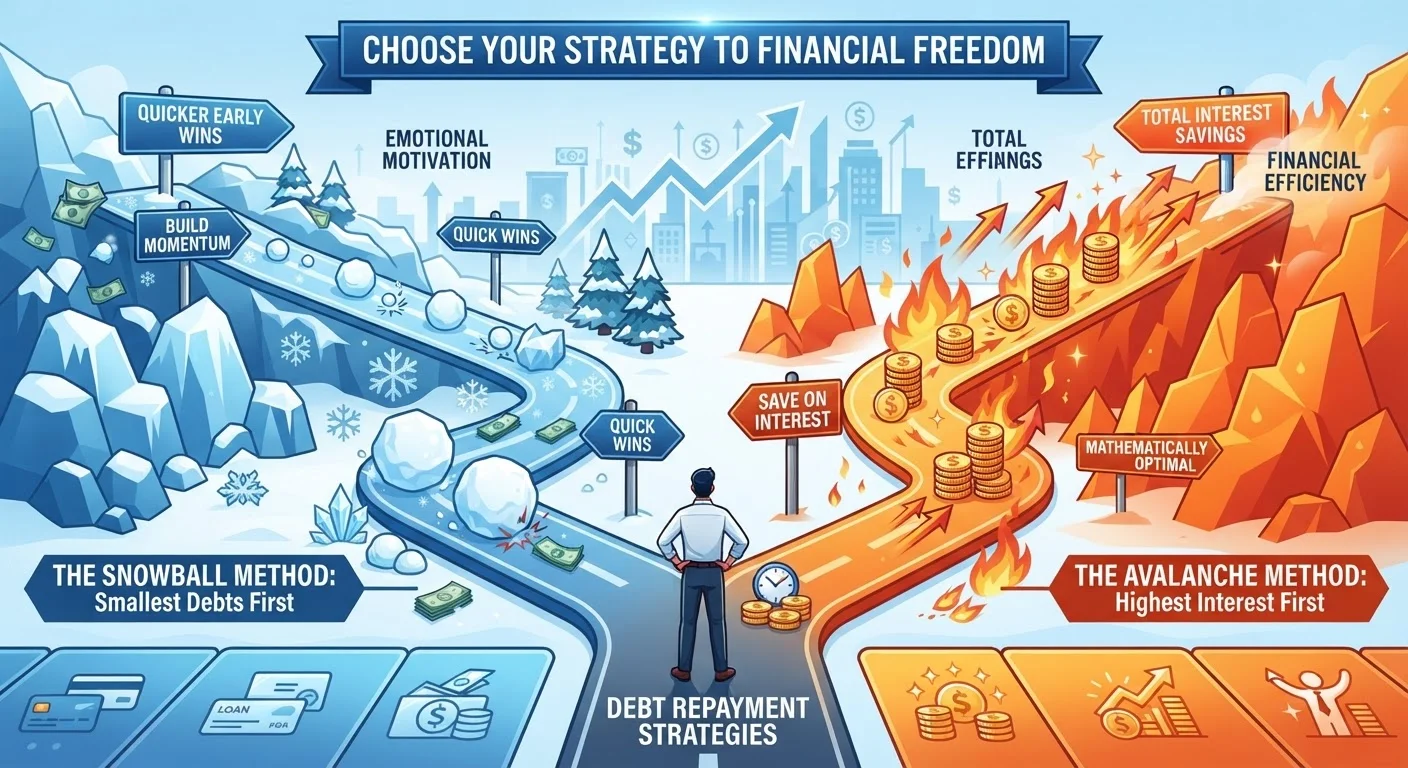
Both the debt avalanche and debt snowball are structured repayment frameworks designed to eliminate multiple debts systematically. They share one core mechanic: you make minimum payments on all debts, then direct any additional funds toward one target account at a time. The difference is how you choose that target.
Debt Avalanche: Rank your debts by interest rate, highest to lowest. Put extra money toward the highest-rate balance. Once it's paid off, roll that payment into the next highest-rate debt. Repeat. Because high-interest debt accumulates cost the fastest, eliminating it first reduces the total amount you pay over time.
Debt Snowball: Rank your debts by outstanding balance, smallest to largest. Put extra money toward the smallest balance. Once it's gone, roll that freed-up payment into the next smallest. Repeat. Each paid-off account delivers a clear, tangible win - a psychological reward that some borrowers find essential for staying committed.
Both methods require discipline and a consistent monthly surplus to redirect toward repayment. If you're looking to free up that surplus, see our budgeting methods guide for approaches that can help create one.
| Criterion | Debt Avalanche | Debt Snowball |
|---|---|---|
| Repayment Order | Highest interest rate first | Smallest balance first |
| Total Interest Paid | Typically lower | Typically higher |
| Time to First Payoff | Potentially longer | Usually faster |
| Psychological Reward | Delayed - tied to interest savings | Early - accounts close quickly |
| Best Rate Environment | Wide spread between rates | Rates are similar across debts |
| Motivation Style | Goal-focused, data-driven | Milestone-driven, momentum-based |
| Complexity | Low - rank by rate | Low - rank by balance |
The Math: Interest Costs and Time to Payoff
In most scenarios with varied interest rates, the avalanche method will result in paying less total interest. The gap can be modest or substantial depending on how far apart the rates are and how long repayment takes. A borrower carrying a high-rate credit card at 24% APR alongside a personal loan at 9% APR would likely pay significantly less overall by targeting the credit card first.
The snowball method, by contrast, may result in paying more interest - because smaller-balance debts aren't always the highest-rate ones. However, research in behavioral economics suggests that visible progress matters: borrowers who see accounts closed are more likely to continue and complete repayment plans. A strategy that gets finished beats one that gets abandoned.
~$1,000+
Potential interest savings with avalanche over snowball
The exact amount varies widely by balance size, rate spread, and repayment timeline - illustrative of why rate targeting matters.
3-5 years
Typical consumer debt repayment horizon
Federal Reserve and consumer finance data consistently show multi-year timelines for households carrying significant revolving debt.
The practical takeaway is that the "best" strategy isn't purely mathematical. It's the one you'll actually sustain. For those whose discipline is solid regardless of short-term milestones, the avalanche has a clear cost advantage. For those who need momentum to stay engaged, the snowball's structure may produce better real-world outcomes - even if the numbers look slightly worse on paper.
It's also worth noting that neither method addresses the underlying cost structure of your debt. If your rates are very high, it may be worth exploring whether debt consolidation could reduce the rate environment before you choose a repayment order.
Choosing the Right Fit for Your Situation
Selecting between the two methods starts with an honest assessment of your debt portfolio and your own behavior patterns. Pull together your account balances, interest rates, and minimum payments. Then ask: Are my rates clustered together or widely spread? How have I responded to setbacks on previous financial goals?
If your rates vary significantly - say, a mix of high-APR credit cards and lower-rate student loans - the avalanche's mathematical edge becomes more meaningful. If your rates are fairly uniform, the snowball's psychological advantage may outweigh the small difference in interest cost.
Your income stability also matters. If you're a freelancer or gig worker, reducing the number of active accounts through the snowball can shrink your monthly minimum obligations - a real buffer during slow months. Our article on managing debt with variable income explores this dynamic in more detail.
Finally, consider where you are in life. Repayment strategy may look different at 28 than at 48. The broader context of managing debt across life stages can help frame how aggressively to pursue payoff relative to other financial priorities like saving or investing.
This article is for general informational and educational purposes only and does not constitute personalized financial, tax, or legal advice. Consult a qualified financial professional before making decisions based on your individual circumstances.