

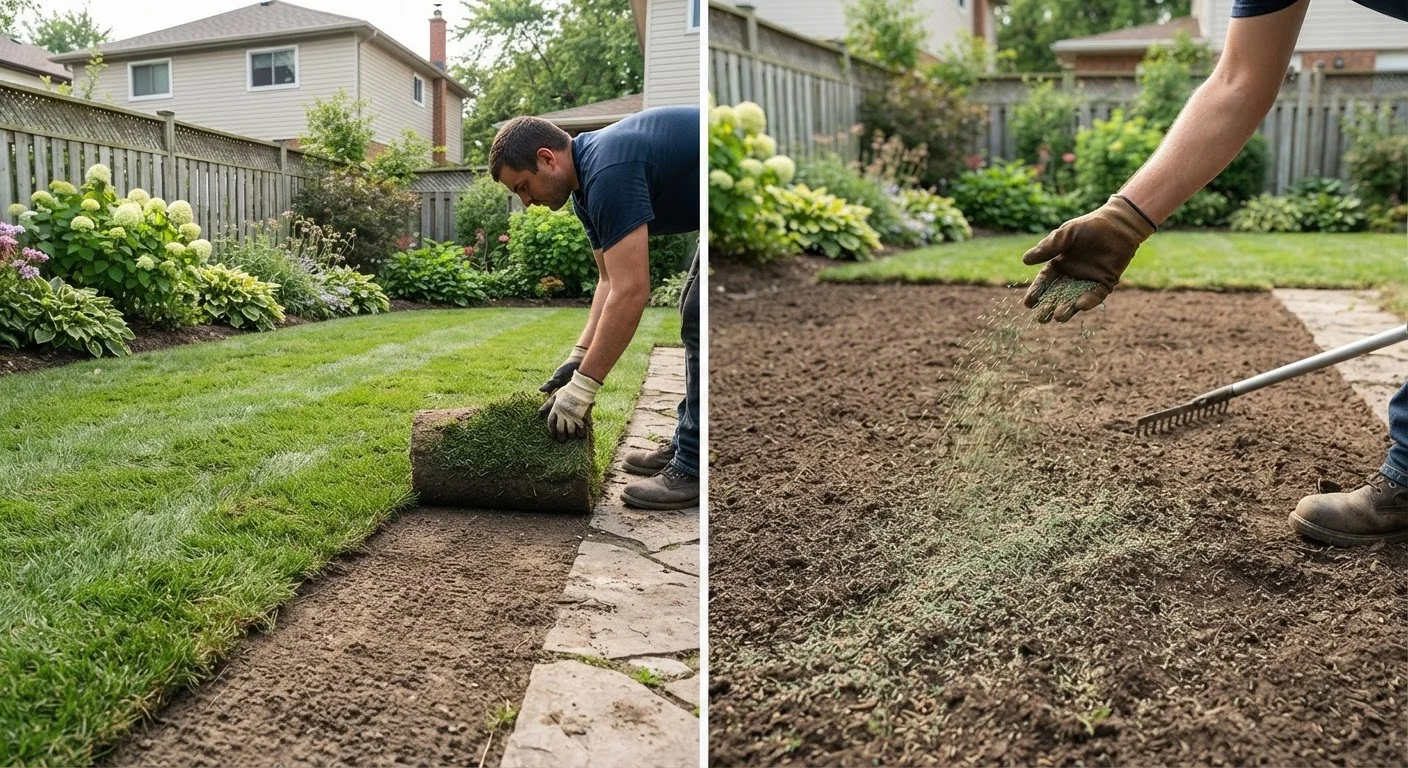
Key Takeaways
- Grass seed costs significantly less per square foot than sod, but takes weeks longer to establish.
- Sod is ready to use within two to three weeks of installation; seed may take two to three months.
- Soil preparation matters equally for both methods - skipping it leads to poor results either way.
- Timing is critical: cool-season grasses establish best in fall, warm-season varieties in late spring.
- Grass seed offers more variety options; sod is limited to what local suppliers grow.
- Both methods require consistent watering during establishment to prevent failure.
Option A
Grass Seed
The patient, budget-conscious approach.
Best for: Homeowners with flexible timing, larger areas to cover, and willingness to invest several weeks in establishment.
Option B
Sod
The instant, higher-investment solution.
Best for: Homeowners who need a usable lawn quickly, especially for erosion-prone slopes or high-visibility areas.
If you're working with a tight budget on a large area
Grass Seed
Seed can cost a fraction of sod per square foot, making it far more practical for covering expansive lawns without significant financial outlay.
If you need a functional lawn within a few weeks
Sod
Sod knits into the soil and becomes walkable in two to three weeks, making it ideal when speed matters - such as before an event or at a newly built home.
If you're repairing a slope or erosion-prone area
Sod
Sod holds soil in place from day one, whereas seed is vulnerable to washing away during rain before roots establish.
If you want a specific grass variety matched to your local conditions
Grass Seed
Seed suppliers offer a much wider selection of cultivars, including regionally adapted blends that may not be available as sod in your area.
If you're a first-time homeowner tackling a bare patch
Grass Seed
Small bare patches respond well to overseeding with minimal preparation, and the process is forgiving enough for beginners to manage confidently.
The Core Difference Between Seed and Sod
At its simplest, grass seed and sod are two delivery systems for the same destination: a healthy, established lawn. Grass seed is exactly that - the raw seed of a grass species, scattered over prepared soil and allowed to germinate. Sod (also called turf) is mature grass that has already been grown by a farm, cut into rolls or slabs with a thin layer of soil attached, and transplanted directly to your yard.
Both methods can produce a dense, durable lawn. The meaningful differences lie in time, cost, labor, and timing - and understanding those differences is how you choose the right approach for your specific situation.
It's also worth noting that neither method substitutes for good soil preparation. Whether you're seeding or sodding, raking, aerating compacted ground, and correcting pH imbalances beforehand will determine how well the lawn establishes. See our year-round lawn care task guide for a broader picture of what your lawn needs through each season.
| Criterion | Grass Seed | Sod |
|---|---|---|
| Upfront cost | Low to moderate | High |
| Time to establish | 8-12 weeks typical | 2-3 weeks typical |
| Usable lawn | 2-3 months minimum | 2-4 weeks after install |
| Variety selection | Wide - many cultivars | Limited to supplier stock |
| Erosion control | Poor until established | Immediate |
| DIY difficulty | Low to moderate | Moderate to high |
| Best install season | Fall (cool-season) / Late spring (warm-season) | Spring through early fall |
| Watering demand | High during germination | High during first 2 weeks |
Cost and Effort: What to Realistically Expect
Grass seed is considerably less expensive than sod per square foot. Sod pricing varies by region, grass type, and supplier, but it consistently runs several times more than comparable seed - a gap that widens significantly on larger lawns. For a typical suburban yard of several thousand square feet, the cost difference can be substantial.
That said, seed demands more of your time. After sowing, you'll water multiple times daily during germination, protect the area from foot traffic and birds, and wait through weeks of uneven coverage before the lawn fills in uniformly. Sod, while pricier, compresses much of that uncertainty into a single installation day.
5-10×
Typical cost difference: sod vs. seed per sq ft
Costs vary by region and grass type, but sod consistently runs several times more per square foot than comparable grass seed.
21 days
Approximate sod rooting time under good conditions
University extension programs generally cite two to three weeks for sod to knit into native soil under proper moisture and temperature conditions.
7-14 days
Typical grass seed germination window
Germination varies widely by species - ryegrass can sprout in five to seven days, while Kentucky bluegrass may take up to three weeks.
Labor costs can also tip the scales. Sod installation is physically demanding - rolls are heavy and must be laid tightly to prevent gaps or drying at the edges. Many homeowners hire this out, adding to the total expense. Seeding a lawn is something most people can accomplish with a broadcast spreader and a garden rake.
Fertilizer strategy applies to both methods. Once established, your lawn will need feeding - see our guide to organic vs. synthetic fertilizers to understand how to choose what fits your approach.
Timing, Watering, and the Establishment Window
Timing is one of the most overlooked variables in the seed vs. sod decision. Cool-season grasses - such as Kentucky bluegrass, fescue, and ryegrass - establish most reliably when seeded in late summer to early fall, when soil is warm and air temperatures are cooling. Sod can be installed across a wider seasonal window because it's already mature, though extreme heat or freezing conditions still slow its rooting.
Warm-season grasses - including Bermuda, zoysia, and St. Augustine - perform best when installed in late spring to early summer, once soil temperatures are consistently warm.
Watering discipline is non-negotiable for both methods during establishment. Seed requires frequent, light watering to keep the soil surface moist without washing seeds away. Newly laid sod needs deep, consistent watering to encourage roots to grow downward into native soil. Poor watering habits are one of the most common reasons both methods fail - our article on lawn watering habits that do more harm than good covers the specific mistakes to avoid.
Once grass is established - whether from seed or sod - your irrigation approach should shift toward deeper, less frequent watering to encourage deep root systems. For guidance on choosing the right delivery method, see our comparison of garden irrigation methods.