

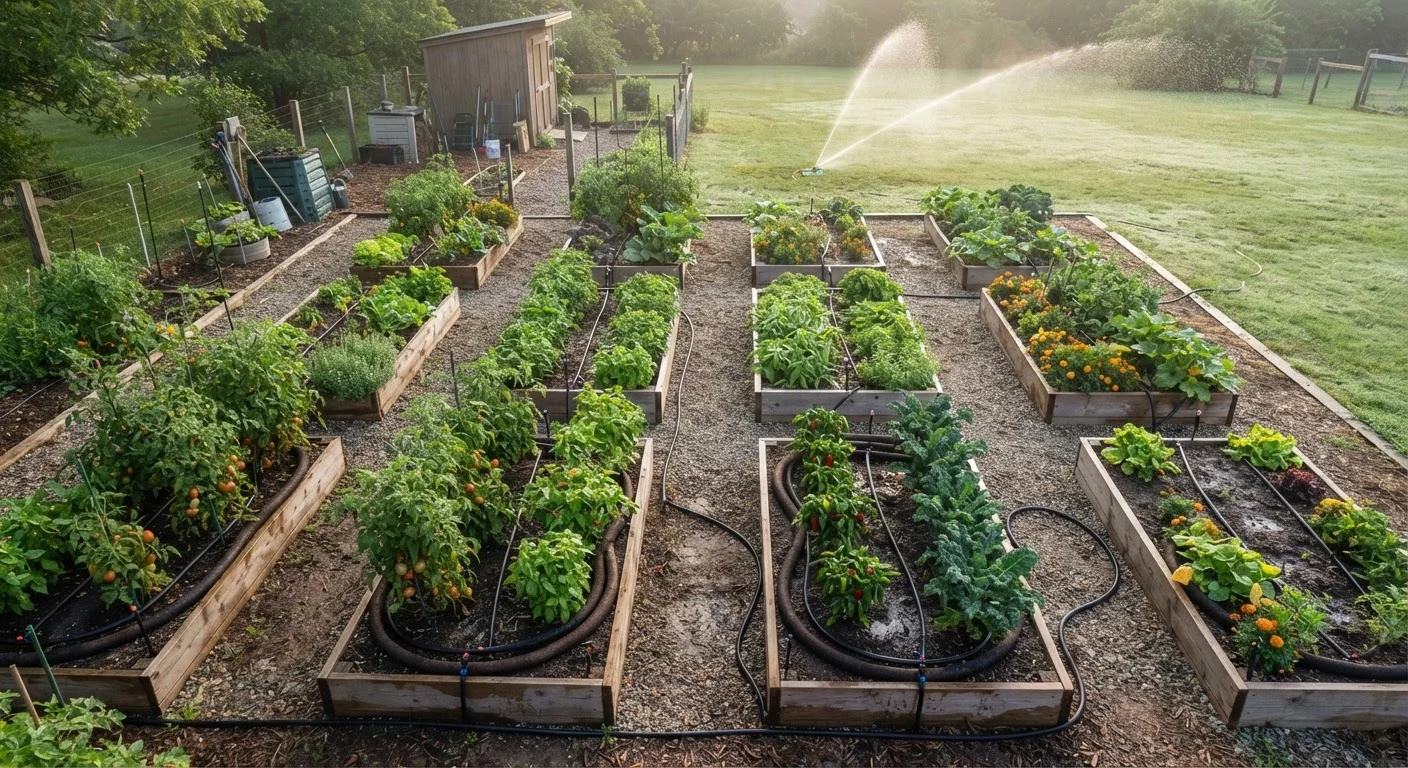
Key Takeaways
- Drip irrigation delivers water directly to plant roots, making it the most water-efficient option for garden beds.
- Sprinkler systems cover large areas quickly but lose more water to evaporation and wind drift.
- Soaker hoses are affordable and simple, ideal for rows and raised beds but not suited for large lawns.
- Each method performs best in specific conditions - no single system suits every garden.
- Pairing any irrigation method with mulch significantly reduces water loss and watering frequency.
Our Verdict
Drip irrigation offers the best water efficiency and precision for established garden beds and vegetable gardens. Sprinkler systems remain the practical choice for lawns and large open areas. Soaker hoses fill a valuable middle ground - low cost, easy to install, and effective for rows of plants or raised beds. The right choice depends on what you're watering, not which system sounds most impressive.
| Best for | Recommended |
|---|---|
| Vegetable gardens, shrub borders, and water-conscious gardeners | Drip Irrigation |
| Lawns, large open garden areas, and newly seeded ground | Sprinkler System |
| Raised beds, row crops, and budget-minded gardeners | Soaker Hose |
How Each System Delivers Water
Understanding how these three irrigation methods work helps clarify where each one makes sense - and where it falls short.
Drip irrigation uses a network of tubes and small emitters (individual nozzles) placed near the base of each plant. Water seeps out slowly and directly into the root zone, rarely touching leaves or bare soil between plants. Systems can be laid on the surface or buried slightly beneath mulch.
Sprinkler systems spray water through the air in a wide arc, mimicking rainfall. They're designed to cover large surface areas uniformly - which is why they're the standard choice for lawns. Pop-up heads are common in permanent in-ground systems; oscillating and rotary sprinklers serve as portable alternatives.
Soaker hoses are porous rubber or recycled-material hoses that sweat water along their entire length at low pressure. You lay them along plant rows or coil them around beds, and they deliver moisture directly to the soil surface. No emitters, no spray - just a slow, steady seep.
| Drip Irrigation | Sprinkler System | Soaker Hose | |
|---|---|---|---|
| Water Efficiency | Very high (90%+ delivered to roots) | Moderate (wind and evaporation losses) | High (direct soil delivery) |
| Best Use Case | Garden beds, trees, shrubs | Lawns, large open areas | Rows, raised beds, borders |
| Setup Complexity | Moderate to high | High (often requires professional install) | Low - minimal tools needed |
| Upfront Cost | Moderate to high | High | Low |
| Maintenance Required | Periodic emitter checks and flushing | Head adjustments, winterization | Replacement every few seasons |
| Foliage Wetting Risk | Very low | High | Very low |
| Automation Potential | Easy with timer | Easy with timer | Possible with timer, less common |
Water Efficiency: Where the Numbers Matter
Water efficiency is often the deciding factor, especially in regions with drought restrictions or high water costs.
90%+
Water efficiency of drip irrigation
The EPA's WaterSense program notes that drip systems can be up to 90% more efficient than conventional sprinkler systems when properly installed.
50%
Water lost to evaporation with sprinklers
According to general water conservation guidance, overhead sprinklers can lose roughly 25-50% of water to evaporation and wind, depending on conditions.
Drip irrigation consistently leads on efficiency because it eliminates the two biggest sources of water waste: evaporation from wet soil surfaces and wind drift carrying water off-target. When emitters are positioned correctly, nearly all water delivered reaches active root zones.
Soaker hoses perform nearly as well in the right conditions. Because they seep directly into soil, evaporation is minimal - particularly when covered with mulch. Their limitation is uniformity: water pressure drops along longer runs, meaning plants at the far end of a long hose may receive less water than those near the source. Keeping runs under 100 feet helps maintain consistent delivery.
Sprinklers are the least efficient option for garden beds but remain the most practical for lawns, where no alternative can realistically cover turf evenly. Running them in the early morning - when temperatures are cooler and wind is calmer - meaningfully reduces losses compared to midday or evening watering.
One commonly repeated gardening myth is that more frequent watering always produces better results. In reality, deep, infrequent watering encourages roots to grow downward toward stable moisture rather than clustering near the surface. Our article on common garden myths addresses this and other widely shared misconceptions.
Setup, Cost, and Maintenance Realities
The practical demands of each system differ significantly, and they're worth weighing honestly before you invest.
Drip systems take more planning upfront. You'll map emitter placement to match plant spacing, calculate pressure requirements, and connect to a water source - typically via a backflow preventer and pressure regulator. Timer-based automation is straightforward once the system is in place, and the payoff in hands-off convenience is real. Maintenance involves periodically flushing lines and checking for clogged or damaged emitters.
Sprinkler systems - particularly in-ground versions - often involve trenching, professional installation, and winterization in cold climates to prevent pipe damage. Portable above-ground sprinklers are far simpler but require manual repositioning. Either way, head alignment should be checked seasonally to avoid watering pavement instead of plants.
Soaker hoses have the lowest barrier to entry. Unroll, position, connect to a hose bib, and you're watering. They're not permanent infrastructure - most gardeners reposition them each season and replace them every few years as the porous material degrades. The tradeoff is that they don't adapt well to large lawns or irregularly shaped beds.
Combine Irrigation With Mulch for Best Results
No matter which irrigation method you choose, applying 2-3 inches of organic mulch over your soil surface dramatically reduces moisture evaporation. This means your irrigation system works less often, your water bill stays lower, and your plants experience less drought stress between watering cycles. See our guide to mulching for practical application tips.
Matching the Right Method to Your Garden
No single irrigation method outperforms the others in every situation. The practical question is matching system to setting.
- Vegetable gardens and raised beds: Drip irrigation or soaker hoses are both strong choices. They keep foliage dry (reducing disease risk), deliver water where roots actually are, and can be automated easily.
- Established shrub and perennial borders: Drip systems shine here. Once installed, they require minimal intervention and can be precisely calibrated to different plant water needs along the same line.
- Lawns: Sprinklers remain the only realistic option for uniform turf coverage. If you're still deciding between grass seed and sod, our comparison of grass seed vs. sod covers how your establishment method can affect early watering needs.
- Container gardens: Drip emitters adapted for pots work well; soaker hoses are generally impractical in containers.
- Large mixed gardens: Many gardeners use a combination - drip or soaker for beds, sprinklers for lawn areas - run on separate zones with individual timers.
Avoid Watering Foliage in the Evening
Sprinkler systems that run in the evening leave foliage wet overnight, which creates conditions favorable for fungal diseases like powdery mildew and leaf blight. If using sprinklers, set timers to run in the early morning so leaves dry quickly after watering. Drip and soaker systems sidestep this issue entirely since they keep water at soil level.
If you're designing a garden from scratch, it's worth thinking about irrigation infrastructure early. Our guide to designing an outdoor space around your lifestyle covers how to plan for practical maintenance needs alongside aesthetics.