

Key Takeaways
- Your owner's manual contains the only maintenance schedule specifically written for your vehicle's make, model, and engine.
- Most schedules list services by mileage intervals and elapsed time - both thresholds matter, not just mileage.
- "Severe" driving conditions apply to more drivers than the label suggests, including frequent short trips and stop-and-go traffic.
- Skipping scheduled services doesn't just risk breakdowns - it can affect warranty coverage and resale value.
- Digital tools and manufacturer apps can help you track service intervals without relying solely on memory.
Start here
Where to Find Your Maintenance Schedule
Next
How Maintenance Schedules Are Organized
Then
Decoding the Most Common Service Items
Important nuance
Normal vs. Severe Driving Conditions
Put it into practice
Keeping Track Without Falling Behind
Where to Find Your Maintenance Schedule
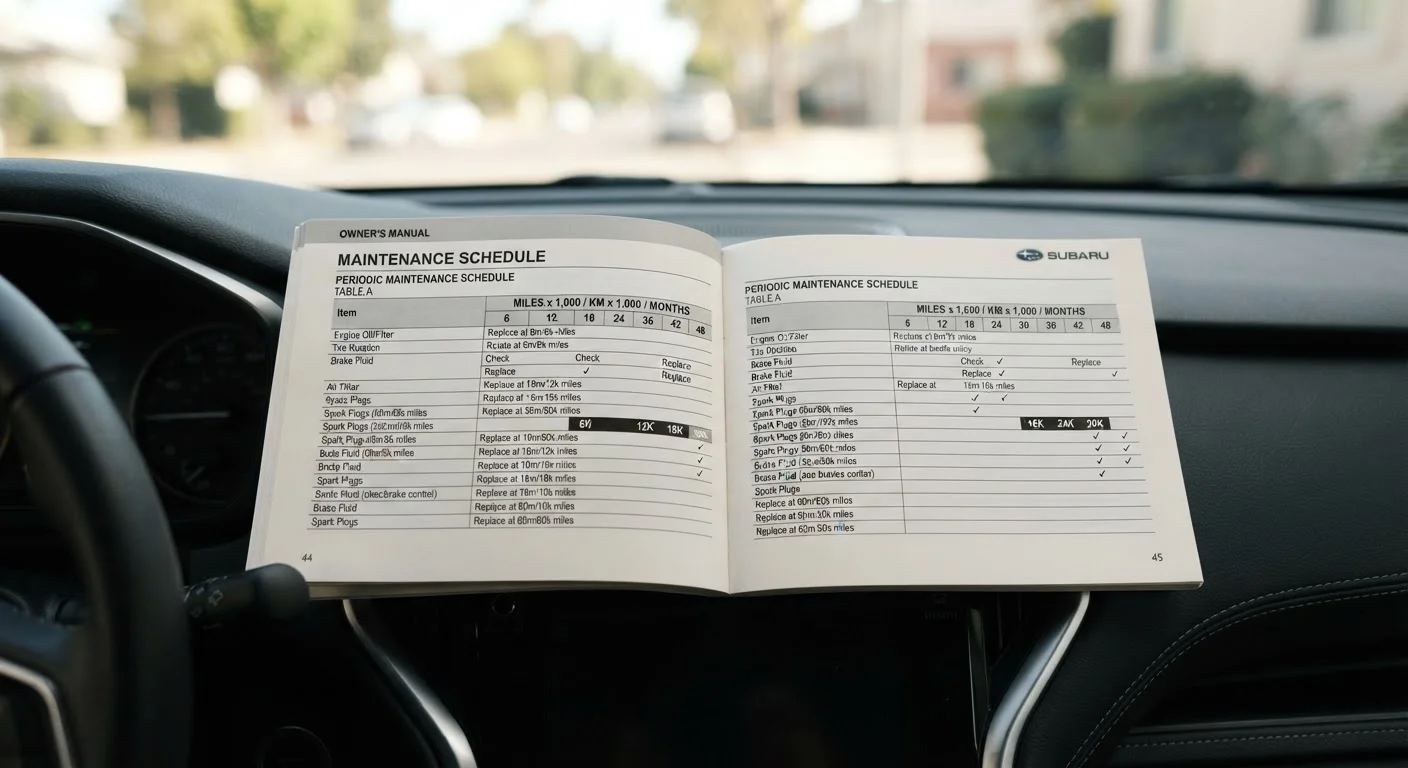
Every vehicle sold in the United States comes with an owner's manual - a document most drivers glance at once and never open again. Buried inside it, however, is the single most accurate guide to your car's upkeep: the manufacturer's maintenance schedule. Unlike generic advice you'll find at a quick-lube counter, this schedule was written specifically for your engine, transmission, and drivetrain.
Find the schedule by checking your manual's index under "Maintenance," "Scheduled Maintenance," or "Service Intervals." If you've lost the physical manual, most automakers publish them online via their owner portals, searchable by your Vehicle Identification Number (VIN). Your VIN appears on a sticker inside the driver's door jamb and on the dashboard near the windshield.
Before diving into the details, it's worth understanding what the schedule is telling you - and what it isn't. It's a framework, not a rigid prescription, but it's the best starting point any driver has. For a broader picture of how maintenance fits across a vehicle's entire life, see our comprehensive roadworthy guide.
Maintenance schedule
A manufacturer-provided list of services and inspections organized by mileage or time intervals, specific to your vehicle's make and model.
Service interval
The recommended mileage or time period between a specific maintenance task - whichever comes first applies.
Severe driving conditions
A category of usage - defined by the manufacturer - that demands more frequent service due to extra engine and component stress, such as frequent short trips or extreme temperatures.
VIN (Vehicle Identification Number)
A unique 17-character code assigned to every vehicle that can be used to look up model-specific information, including the owner's manual and maintenance data.
Coolant flush
A service that drains and replaces the engine's coolant fluid, which prevents overheating and corrosion inside the cooling system.
Oil life monitor
An onboard system that uses driving data and algorithms to estimate how much useful life remains in your engine oil, displaying a percentage or alert on the dashboard.
How Maintenance Schedules Are Organized
Most manufacturer schedules present services in one of two formats: a mileage-based table (e.g., every 5,000, 15,000, or 30,000 miles) or a time-based calendar (e.g., every 6 or 12 months). The critical detail many drivers miss: whichever threshold comes first applies. A vehicle that sits in a garage for a year but has only accumulated 2,000 miles still needs time-sensitive services like brake fluid inspection.
Schedules are typically divided into two tracks:
- Normal conditions - standard intervals for drivers whose usage fits average patterns.
- Severe or special conditions - more frequent intervals for demanding driving situations (covered in detail below).
Some manuals also use an "A" and "B" service system or numbered inspection levels that bundle multiple tasks together. When you see these, look for the corresponding legend - it will spell out exactly what each letter or number includes.
Decoding the Most Common Service Items
Knowing what each line item actually involves removes the guesswork when you're at a shop or planning your budget. Here are the services you'll encounter most often:
- Engine oil and filter
- The foundation of engine health. Modern synthetic oils and improved engine tolerances have extended intervals well beyond the old 3,000-mile rule. Your manual's specific interval is the right target - not a generic recommendation. See why oil change intervals have changed for more context.
- Tire rotation
- Rotating tires evens out wear patterns that develop naturally from the weight distribution of your vehicle. Most schedules recommend rotation every 5,000-7,500 miles. How tire rotation protects tread life is a topic worth understanding before skipping this service.
- Air filter (engine)
- A clogged air filter restricts airflow to the engine, reducing efficiency. Typical replacement intervals range from 15,000 to 30,000 miles, but dusty environments accelerate this.
- Brake fluid
- Brake fluid absorbs moisture over time, which lowers its boiling point and reduces braking effectiveness. Many manufacturers recommend inspection or replacement every two years regardless of mileage.
- Spark plugs
- Worn spark plugs cause misfires and reduced fuel economy. Conventional plugs may need replacement around 30,000 miles; iridium or platinum plugs can last 60,000-100,000 miles depending on the application.
- Coolant flush
- Engine coolant degrades and becomes acidic over time. Schedules vary widely - some manufacturers call for replacement at 5 years or 100,000 miles. Our fluid guide covers what each reservoir does and how to check it.
Check Both Thresholds Every Time
When reviewing your schedule, always note both the mileage and the time-based interval for each service. A vehicle used infrequently can still reach a time threshold - such as annual brake fluid inspection - long before the mileage trigger. Treating time intervals as optional is one of the most common maintenance oversights.
Normal vs. Severe Driving Conditions
The "severe" label is one of the most misunderstood parts of any maintenance schedule. It doesn't mean racing or off-roading. Manufacturers define severe conditions to include:
- Frequent trips of five miles or fewer (the engine never fully warms up)
- Prolonged stop-and-go traffic or idling
- Driving in extreme heat or cold
- Towing, hauling heavy loads, or driving on unpaved roads
- Operating in dusty, sandy, or salted environments
If your daily commute involves urban traffic, short errands, or harsh winters, you likely qualify for the severe schedule - which typically calls for shorter intervals on oil, filters, and inspections. Ignoring this distinction is one of the most common ways drivers underservice their vehicles while believing they're on track.
For drivers in climates with dramatic seasonal swings, seasonal vehicle prep pairs well with your maintenance schedule to catch condition-specific needs.
Keeping Track Without Falling Behind
Reading your maintenance schedule is only half the task - staying on top of it is the other. A few practical approaches help:
- Create a simple log. A spreadsheet or even a notebook kept in the glove box recording each service, the date, and the odometer reading gives you a clear picture at a glance.
- Use manufacturer tools. Many automakers offer owner portals or mobile apps tied to your VIN that display upcoming services and let you log completed ones.
- Set calendar reminders. For time-based services like brake fluid inspection, a recurring annual reminder prevents the interval from slipping by unnoticed.
- Review records before buying or selling. A complete service history is a meaningful asset at trade-in or private sale - and a gap in records often raises questions.
If your vehicle is approaching or past 100,000 miles, note that some service items intensify in frequency or scope. Maintenance needs after 100,000 miles differ meaningfully from earlier in a vehicle's life. Staying organized now means fewer surprises - and catching issues before they escalate. See how to spot small problems early for what to watch between scheduled visits.