

Key Takeaways
- Different wheel positions wear tires at different rates, making rotation essential for even tread life.
- Most manufacturers recommend rotating tires every 5,000-7,500 miles, often aligned with oil changes.
- Skipping rotations can shorten tire lifespan significantly and compromise braking and handling.
- All-wheel-drive vehicles are especially sensitive to uneven tire wear due to how their differentials work.
- Tire rotation is one of the lowest-cost maintenance tasks with one of the highest returns on vehicle safety.
Tire Rotation
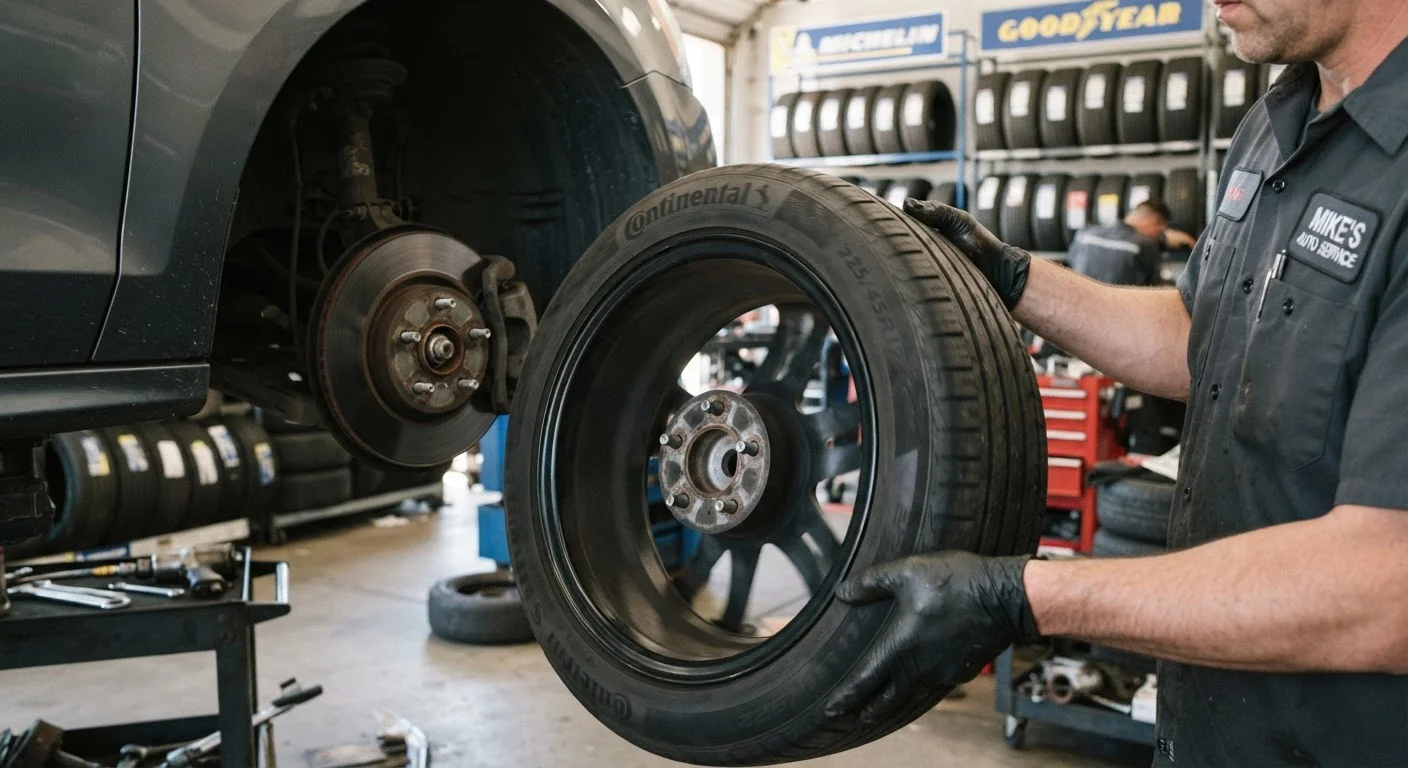
Tire rotation is the practice of moving each tire to a different position on your vehicle at regular intervals - for example, swapping front tires to the rear and vice versa. Because different wheel positions experience different amounts of stress, tires wear unevenly if left in place. Rotating them redistributes that wear so all four tires degrade at a more similar rate, extending their usable life.
Rotation patterns vary by drivetrain (front-wheel drive, rear-wheel drive, all-wheel drive) and whether the vehicle uses directional or non-directional tires, so the specific pattern your vehicle needs may differ from the generic front-to-back swap.
Why Tires Wear Unevenly in the First Place
To understand why rotation matters, you first need to understand why tires don't wear at the same rate on their own. Physics is the short answer. Every tire on your car is doing a slightly different job, and that job determines how quickly it degrades.
On a front-wheel-drive vehicle - the most common configuration in American cars - the front tires handle steering, acceleration, and a significant share of braking. That's a lot of mechanical demand concentrated on two tires. The rear tires, comparatively, are just along for the ride. Studies consistently show front tires on FWD vehicles can wear up to twice as fast as rear tires when not rotated.
On rear-wheel-drive vehicles, propulsion shifts to the back, which loads those tires differently. All-wheel-drive systems spread power across all four wheels but still subject different axles to different forces depending on vehicle weight distribution and cornering dynamics.
Braking load, steering input, vehicle weight bias, and road camber all contribute to how each tire degrades. Left to its own devices, one tire may be nearly bald while another still has significant life remaining - a costly and avoidable outcome. See our guide to tire pressure and handling for a related look at how operating conditions affect your tires.
2×
Faster front tire wear on FWD vehicles
Industry testing and tire manufacturer data consistently show front tires on front-wheel-drive vehicles can wear at roughly twice the rate of rear tires when rotation is neglected.
$20-$50
Typical cost of a tire rotation service
According to automotive service industry pricing data, a standalone tire rotation is among the lowest-cost maintenance services available, often bundled free with other services.
5,000-7,500 mi
Recommended rotation interval
Most vehicle manufacturers specify this interval in their owner's manuals, though some high-performance or AWD vehicles may call for more frequent rotation.
How Rotation Works - and What Pattern Applies to You
Tire rotation doesn't mean randomly shuffling tires. There are established patterns based on your vehicle's drivetrain and tire type.
- Forward cross (FWD): Front tires move straight to the rear; rear tires cross to opposite sides at the front. This compensates for the heavier front-axle load.
- Rearward cross (RWD/AWD): Rear tires move straight to the front; front tires cross to opposite sides at the rear.
- X-pattern: All four tires cross to the opposite axle and opposite side simultaneously. Used in specific cases where wear is especially uneven.
- Directional tires: Tires with a V-shaped tread pattern designed to rotate in one direction can only be moved front-to-rear on the same side - they cannot be crossed without dismounting the tire from the rim.
Your owner's manual will specify the correct pattern for your vehicle. If your car has a full-size spare that matches the other four tires, some manufacturers recommend including it in the rotation as a fifth tire. Consulting your maintenance schedule guide can help you locate this information quickly.
Align Rotation With Your Oil Changes
Many service shops offer tire rotation bundled with oil changes, making it easy to stay on schedule. If your oil change interval falls within the 5,000-7,500 mile rotation window, combining the services saves you a separate trip and helps you track both at once. Check your owner's manual to confirm the intervals align for your specific vehicle.
The Real Cost of Skipping Tire Rotation
Tire rotation typically costs between $20 and $50 at most service centers - or nothing if it's bundled with an oil change package. By contrast, a set of four replacement tires for a typical passenger vehicle can run anywhere from $400 to well over $1,000 installed, depending on size and type.
The math is straightforward: a few skipped rotations can translate into needing new tires thousands of miles earlier. But the financial hit is only part of the picture.
Uneven tread wear creates real safety consequences. A tire that's severely worn on one edge but not the other has reduced contact with the road during braking and cornering. Wet-weather performance degrades notably because tread channels that evacuate water from under the tire become shallower unevenly. Handling becomes less predictable - a particular concern in emergency maneuvers.
For AWD vehicles, the stakes are even higher. Most AWD systems rely on all four tires being within a narrow range of tread depth to function properly. Significant tread discrepancies force the center differential to compensate constantly, leading to premature wear on the drivetrain itself - a repair that dwarfs the cost of a few tire rotations.
For a broader look at what deferred maintenance accumulates into, our analysis of skipping scheduled maintenance covers the full picture. And if you're weighing whether to do this yourself or take it in, our guide on DIY vs. shop maintenance can help you decide.