

Key Takeaways
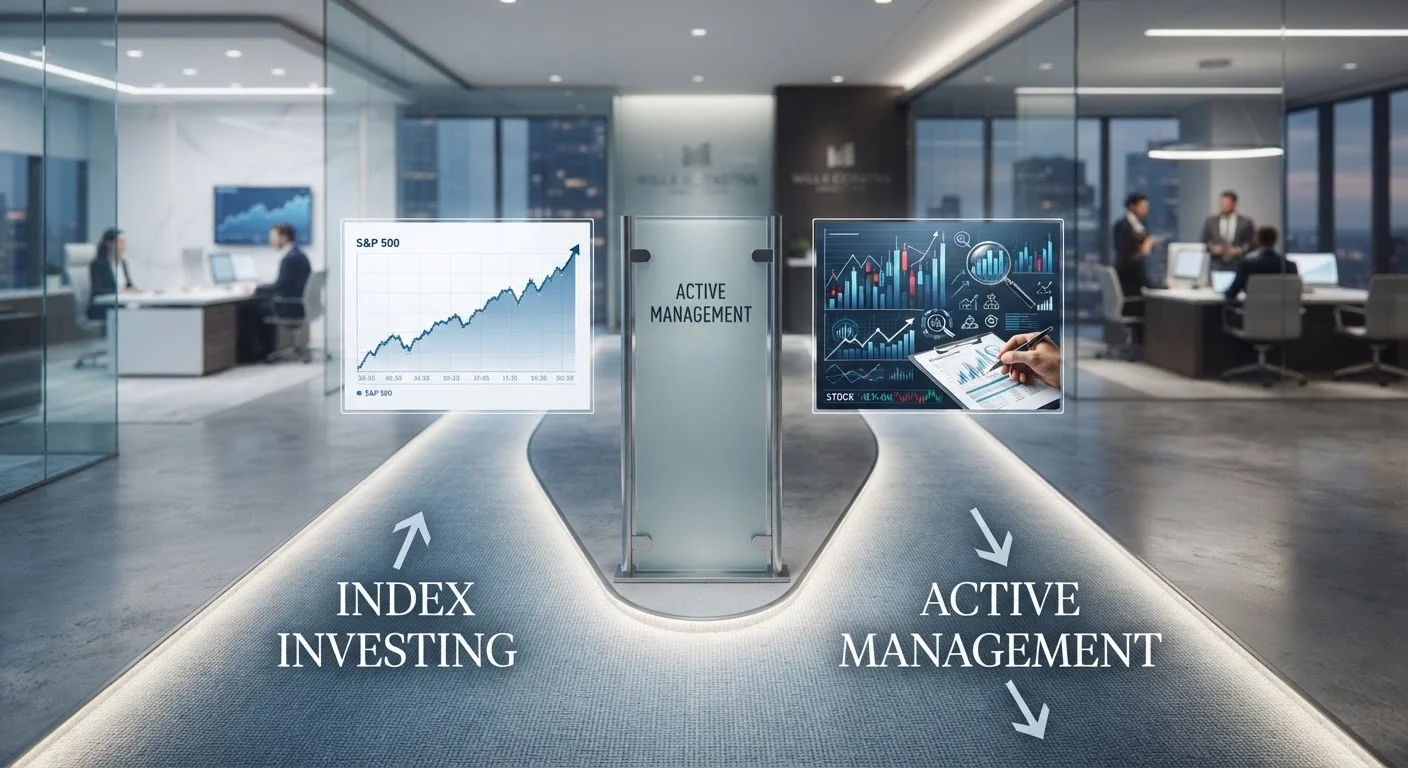
- Index funds track a market benchmark passively; actively managed funds rely on portfolio managers making deliberate investment decisions.
- Actively managed funds generally charge significantly higher fees, which directly reduce your net returns over time.
- Research consistently shows most actively managed funds underperform their benchmark index over long time horizons.
- Index funds offer broad diversification automatically, while active funds may concentrate holdings based on a manager's outlook.
- Neither approach guarantees returns - all investing carries risk of loss.
Option A
Index Funds
The passive, low-cost approach to broad market participation.
Best for: Investors who want predictable market-matching returns with minimal fees and hands-off management.
Option B
Actively Managed Funds
The expert-driven strategy seeking to outperform the market.
Best for: Investors comfortable paying higher fees for professional stock selection in pursuit of above-market returns.
If you're a beginner wanting a simple, low-cost starting point
Index Funds
Index funds require no specialized knowledge to use, carry lower fees, and historically keep pace with broad market performance - making them a practical entry point for new investors.
If you want professional management in a specific niche market
Actively Managed Funds
In less-efficient market segments - such as small-cap international stocks - skilled managers may have more opportunity to add value, though higher fees remain a real cost.
If minimizing investment costs is your top priority
Index Funds
Index funds routinely carry expense ratios well below 0.10%, while actively managed funds often charge 0.50%-1.00% or more annually - a gap that compounds significantly over decades.
If you're investing inside a tax-advantaged retirement account
Index Funds
Index funds tend to generate fewer taxable events due to lower portfolio turnover, making them well-suited for long-term retirement accounts like IRAs or 401(k)s.
How Each Approach Works
Before comparing outcomes, it helps to understand the mechanics. If you're new to investing altogether, our introduction to what investing actually means is a useful starting point.
An index fund is designed to mirror the performance of a specific market index - for example, the S&P 500, which tracks 500 large U.S. companies. The fund holds the same securities in roughly the same proportions as the index. No one is making active decisions about which stocks to buy or sell; the portfolio simply follows the index. This is called passive investing.
An actively managed fund works differently. A professional portfolio manager - supported by a research team - studies market data, company financials, and economic trends to hand-pick investments they believe will outperform the broader market. The fund's composition reflects those human judgments, and holdings change as the manager's views evolve.
Both are types of pooled investment vehicles, meaning many investors contribute money that is combined and managed collectively. For a broader explanation of how funds fit into a portfolio alongside stocks and bonds, see our guide to the building blocks of most portfolios.
| Criterion | Index Funds | Actively Managed Funds |
|---|---|---|
| Management style | Passive - tracks an index | Active - manager selects holdings |
| Typical expense ratio | Under 0.10% annually | 0.50%-1.00%+ annually |
| Goal | Match market benchmark returns | Beat the market benchmark |
| Portfolio turnover | Low - changes only when index changes | Higher - reflects manager decisions |
| Diversification | Broad, automatic, index-driven | Varies by fund strategy |
| Long-term performance vs. benchmark | Generally matches benchmark after fees | Most underperform benchmark after fees |
| Tax efficiency | Generally higher (fewer taxable events) | Generally lower (more trading activity) |
Cost, Performance, and What the Data Shows
The single biggest structural difference between these two fund types is cost. Index funds carry very low expense ratios - the annual fee expressed as a percentage of your investment. Many broad-market index funds charge less than 0.10% per year. Actively managed funds typically charge between 0.50% and 1.00% or more, because you're paying for the manager's expertise and research infrastructure.
That gap compounds over time. On a $50,000 investment growing at 7% annually, an extra 0.75% in annual fees can cost tens of thousands of dollars over 30 years - money that would otherwise stay in your portfolio.
85%+
Active large-cap funds underperforming over 15 years
S&P Global's SPIVA scorecards have repeatedly shown that over 15-year periods, the substantial majority of actively managed large-cap U.S. equity funds trail the S&P 500 after fees.
~0.03%-0.10%
Typical index fund annual expense ratio
Many broad-market index funds available to retail investors carry expense ratios well below 0.10%, according to publicly available fund prospectus data.
0.50%-1.00%+
Typical active fund annual expense ratio
Actively managed equity mutual funds commonly charge between 0.50% and 1.00% or more annually, reflecting the cost of professional management and research.
On performance, the evidence is striking. Data from S&P Global's SPIVA (S&P Indices Versus Active) scorecards - published regularly and tracking fund performance across categories - has consistently found that the large majority of actively managed U.S. equity funds underperform their benchmark index over 10- and 15-year periods, after fees. This doesn't mean active managers never outperform; some do, particularly in shorter windows or in specific market segments. But identifying those managers in advance, consistently, is difficult.
It's important to note that past performance does not guarantee future results, and all funds - index or active - can lose value. Investing always involves risk. For a plain-language glossary of terms like expense ratio, benchmark, and portfolio turnover, see our investing terms reference for beginners.
Which Fund Type Fits Your Situation?
There's no single right answer for every investor - your choice depends on your goals, timeline, comfort with fees, and how much you want to be involved in investment decisions.
For most beginners, index funds offer a straightforward, evidence-backed foundation. They're widely available inside employer retirement plans like 401(k)s, and inside individual retirement accounts. If you're weighing how to structure a retirement account, our comparison of Roth IRA vs. Traditional IRA tax differences explains how each account type handles taxes - which affects which fund type you might prefer inside each.
Actively managed funds may be worth considering if you have specific goals that a passive fund can't serve - for instance, a fund focused on a very narrow sector or a strategy that actively manages downside risk. But go in with clear eyes about the fees and the historical performance context.
Some investors choose both: a core of low-cost index funds for long-term, broad market exposure, with a smaller allocation to active strategies in specific areas. This isn't a recommendation for any individual - consult a licensed financial adviser to assess what structure fits your actual circumstances, tax situation, and risk tolerance.
This article is for general informational and educational purposes only. It is not personalized financial or investment advice. All investing involves risk, including the possible loss of principal. Consult a qualified financial professional before making investment decisions.