

Key Takeaways
- Generic store-bought kits rarely cover all the scenarios real travel throws at you.
- Your destination, trip length, and personal health history determine what belongs in your kit.
- Medications that are available over-the-counter in the U.S. may be restricted or unavailable abroad.
- Always verify prescription and controlled medication rules with your destination country before traveling.
- Consult a healthcare provider before your trip to address destination-specific health risks.
Summary
24 items · 30-60 minutes to assemble
Why a Generic Kit Usually Falls Short
Most pre-packaged first aid kits are designed for minor household accidents - a scraped knee, a paper cut. They're not built for a week in rural Costa Rica, a road trip through the desert Southwest, or a city break in Southeast Asia. If you're putting real thought into how every layer of your trip fits together, your health preparation deserves the same attention.
A travel-ready kit accounts for three things a generic kit doesn't: the specific risks of your destination, the length of your trip, and your personal medical needs. Building one from scratch takes less than an hour and gives you far more confidence than a factory-sealed box of adhesive bandages.
Check Medication Rules Before You Pack
Some common U.S. over-the-counter medications - including certain antihistamines, codeine-based pain relievers, and stimulants - are restricted or illegal in other countries. Carrying them without proper documentation can result in confiscation or serious legal consequences. Always verify the rules with the destination country's official embassy or consulate, and carry a doctor's letter for any prescription medication you're bringing.
The items below are grouped by function. Before you travel internationally, check which medications can legally be brought into your destination country. Some antihistamines, pain relievers, and prescription drugs are controlled or banned in certain countries. Verify with the destination country's embassy or consulate before you pack.
What to Pack: The Full Checklist
Use the checklist below as your building guide. Start with the "must" items as your non-negotiable base layer, then add "should" items based on your trip type and destination. "Nice to have" items are worth including if you have space and are traveling somewhere remote or for an extended period.
Wound Care
Medications
Sun, Insect, and Environmental Protection
Tools and Documentation
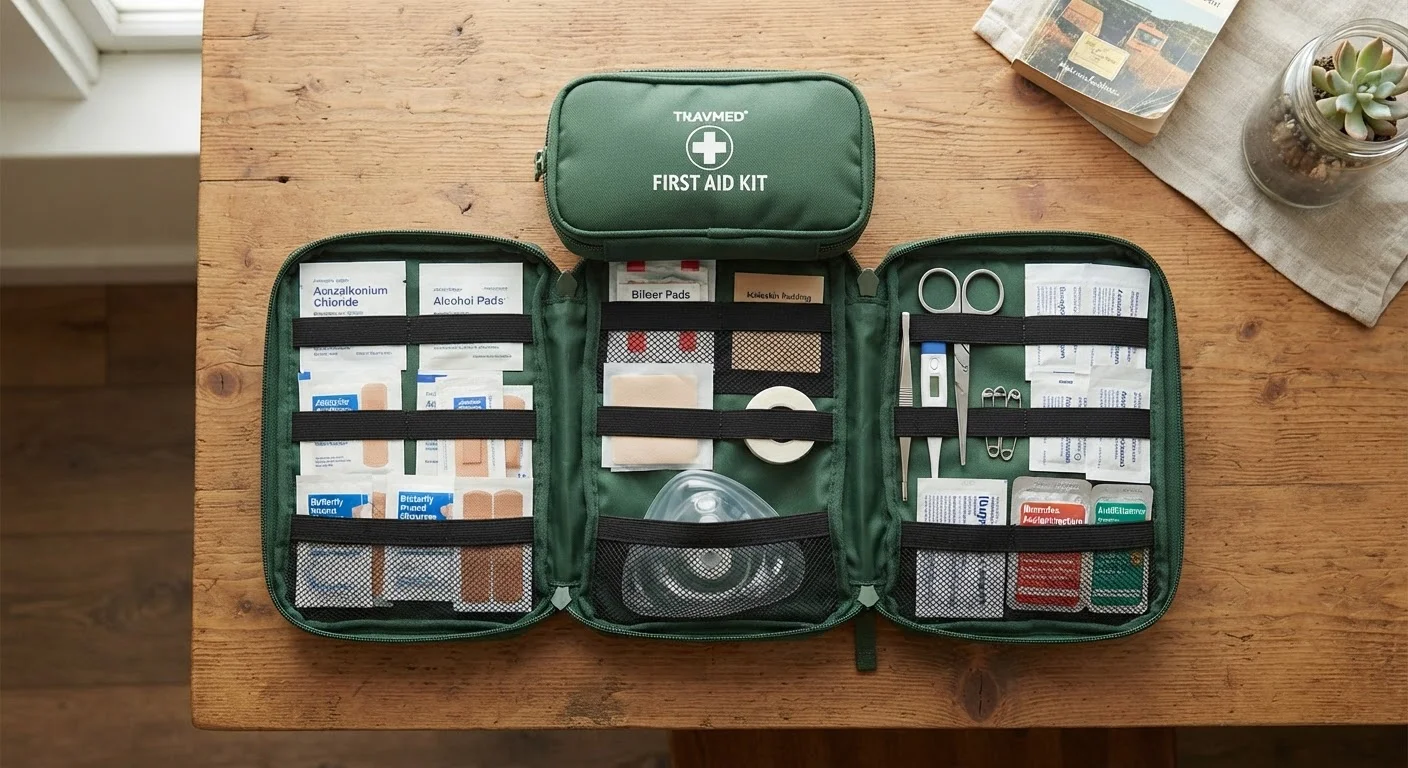
When reviewing your kit, also think about the container itself. A compact, water-resistant pouch with clear zippered compartments keeps everything organized and accessible. If you're flying, note that the TSA's 3-1-1 liquids rule applies to gels, creams, and liquid medications in carry-on bags - check current TSA guidelines before packing.
Tailoring Your Kit to Your Trip
The checklist above covers most travelers, but the right kit shifts based on where you're going and what you're doing. A beach vacation in Florida has very different risks than trekking in high-altitude Peru or backpacking through areas with limited medical access.
- Tropical or developing-world destinations: Add oral rehydration salts, water purification tablets, and insect repellent with at least 20% DEET. Talk to a travel medicine provider about destination-specific concerns well before departure.
- Cold-weather or high-altitude trips: Add lip balm with SPF, hand warmers, and blister care supplies for heavy boot use. Altitude sickness is a real concern above 8,000 feet - consult a healthcare provider about your options.
- Adventure or remote travel: Consider a SAM splint, a more comprehensive wound closure kit, and a larger supply of any prescription medications. Access to pharmacies may be days away.
- Traveling with children or elderly companions: Adjust medication dosages to match their needs only under a healthcare provider's guidance, and include age-appropriate items such as children's pain reliever or compression socks.
Don't Rely on Your Kit Alone
A travel first aid kit is designed to handle minor injuries and bridge the gap until professional medical care is available - not to replace it. If you experience a serious injury, high fever, signs of severe allergic reaction, or symptoms that worsen, seek qualified medical attention promptly. Know how to contact emergency services at your destination before you need them.
For a broader view of staying healthy abroad, see our guide to health and safety for first-time international travelers. And if you're still in the early stages of trip planning, this starting-point guide for first-time trip planners can help you sequence your preparation correctly.
This article provides general travel health information for educational purposes only and is not a substitute for personalized medical advice. Consult a qualified healthcare provider before traveling, especially regarding vaccinations, prescription medications, and destination-specific health risks.