

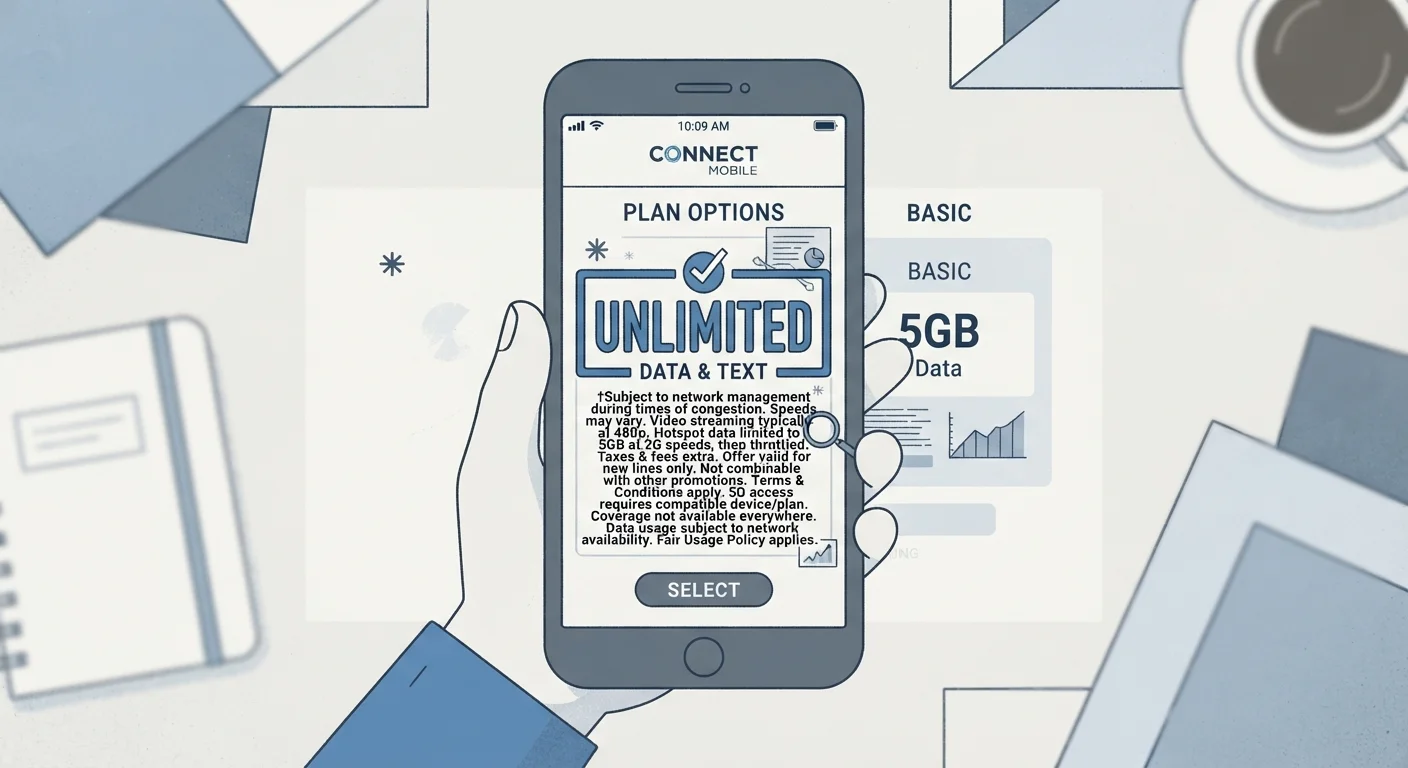
Key Takeaways
- "Unlimited" data plans almost always include speed throttling after a set usage threshold.
- Deprioritization can slow your connection during network congestion, even before you hit any cap.
- Mobile hotspot data on unlimited plans is typically capped or speed-limited separately from phone data.
- Video streaming quality is often restricted by default on lower-tier unlimited plans.
- Higher-priced unlimited tiers generally offer more full-speed data and fewer restrictions.
Why "Unlimited" Doesn't Mean What It Sounds Like
When carriers advertise unlimited plans, the word is doing a lot of marketing work - and not much literal describing. The term is permitted under Federal Trade Commission guidelines as long as the material restrictions are disclosed, typically in fine print or a terms-of-service document most subscribers never read. The result is a gap between consumer expectation and contractual reality that affects tens of millions of American wireless customers.
Understanding what unlimited actually means in practice requires knowing three distinct mechanisms carriers use to manage their networks: data throttling (slowing speeds after a usage threshold), deprioritization (reducing your speed relative to other users during congestion), and feature-specific caps (separate limits on hotspot, video, or gaming data). Each operates differently and affects your experience in different ways. For a plain-English breakdown of these and other industry terms, see our wireless carrier jargon guide.
Myth
An unlimited data plan means I can use as much data as I want at full speed, all month long.
Fact
Most unlimited plans reduce speeds - sometimes dramatically - after you consume a specified amount of high-speed data in a billing cycle.
This practice is called soft data throttling or a premium data threshold. Once you exceed the threshold - which varies by plan and tier, but commonly ranges from 25 GB to 100 GB or more - your data speeds are reduced for the remainder of the billing cycle. The reduction can bring speeds down from typical 4G LTE or 5G rates to speeds comparable to older 3G networks, which are often insufficient for video streaming or video calls. The carrier is technically still providing data; they're just slowing it significantly. This detail is disclosed in plan terms, but the advertising rarely makes it prominent.
Myth
Deprioritization and throttling are the same thing.
Fact
Throttling is a fixed speed reduction tied to your usage; deprioritization is a dynamic slowdown that can happen to any unlimited customer during network congestion, regardless of how much data they've used.
Deprioritization means that during periods of high network demand, customers on unlimited plans may be placed lower in the queue for available bandwidth than customers on other plan types. This can occur even if you've used very little data that month. The effect is temporary - it eases when congestion clears - but in dense urban areas, stadiums, or during peak evening hours, it can meaningfully degrade performance. Premium unlimited tiers on most carriers include provisions for higher deprioritization thresholds or reduced deprioritization frequency, which is one of the core reasons higher tiers carry higher monthly costs.
Myth
My unlimited plan includes unlimited mobile hotspot at full speed.
Fact
Hotspot data on unlimited plans is almost always capped at a set number of gigabytes at high speed; after that, speeds are reduced significantly.
Carriers treat mobile hotspot - using your phone to share its cellular connection with a laptop, tablet, or other device - as a separate data category from your phone's own usage. On entry-level unlimited plans, the high-speed hotspot allotment is frequently quite limited. Once exhausted, hotspot speeds typically drop to 600 Kbps or lower, which is far below what most modern applications require. Premium unlimited tiers generally include larger high-speed hotspot allotments, and some plans offer the option to purchase additional hotspot data as an add-on mid-cycle.
Myth
If I pay for an unlimited plan, my video will always stream at the highest quality my phone supports.
Fact
Many unlimited plans cap video streaming resolution by default, regardless of your device's capability or your network signal strength.
Carriers implement video optimization - a term that often means compression and resolution capping - as a network management practice and, in some cases, as a feature differentiator between plan tiers. On lower-tier plans, video may be capped at 480p or 720p even when your device and signal could technically support higher resolution. This is typically invisible during casual phone viewing but becomes noticeable on larger screens or when using the phone as a hotspot to stream content. Checking your plan's video policy in account settings - and understanding whether a higher tier removes the cap - is worthwhile before assuming you're getting full-quality streaming.
Myth
All unlimited plans are essentially the same; you're just paying more for branding.
Fact
Unlimited tiers differ in meaningful, practical ways: the amount of full-speed data before throttling, hotspot allotments, video resolution limits, and deprioritization policies all vary significantly between tiers.
The difference between a carrier's entry-level and premium unlimited plan often includes a substantially higher premium data threshold before throttling, a larger high-speed hotspot allocation, no video resolution cap, and a higher deprioritization threshold. For a light user who primarily browses and streams music, an entry-level plan may be entirely adequate. For someone who regularly uses mobile hotspot for work, streams high-definition video, or lives in a congested urban area, those distinctions can have a real impact on day-to-day experience. Comparing plan tiers on the same carrier side by side - specifically looking at the terms rather than the marketing copy - is the most reliable way to evaluate the difference. Our article on questions to ask before signing a carrier contract can help structure that evaluation.
Tiers, Hotspots, and Video: The Hidden Variables
Most major carriers structure their unlimited offerings as a ladder of tiers - often three levels - with the entry-level plan carrying the most restrictions and the premium tier offering the fewest. The differences between tiers are rarely about whether data is capped; they're about how much full-speed data you get, how aggressively your video is compressed, and how much mobile hotspot data is included at usable speeds.
3
Typical number of unlimited plan tiers per major carrier
Most major U.S. carriers structure their unlimited offerings across entry, mid, and premium tiers with distinct data and feature thresholds at each level.
600 Kbps
Common hotspot speed after high-speed allotment is exhausted
Many carrier plan terms specify that hotspot speeds drop to around 600 Kbps once the high-speed allotment is used - well below what video streaming typically requires.
Mobile hotspot access deserves special attention. Even on plans that advertise unlimited hotspot, the high-speed allotment is typically a fixed number of gigabytes per billing cycle. Once that allotment is exhausted, hotspot speeds are reduced - often to 3G-era speeds that make video streaming or video calls impractical. This is a separate bucket from your phone's own data, meaning you can hit the hotspot ceiling while your phone still shows full-speed browsing.
Video streaming restrictions are similarly layered. Many lower-tier unlimited plans cap video resolution at 480p (standard definition) or 720p by default. This is largely invisible until a user tries to cast content to a television or notices degraded quality on a larger screen. Some plans allow you to disable the cap within account settings, though doing so may affect other plan features or pricing.
Before switching or upgrading, it's worth reviewing exactly what you're agreeing to. Our guide on reading a wireless plan before you commit walks through the specific fine-print clauses that matter most.
Don't Assume Your Plan Includes 5G at Full Speed
Even on unlimited plans, access to a carrier's fastest 5G tier (sometimes labeled mmWave or Ultra Wideband) may be restricted to specific premium plan tiers or require a compatible device. Lower-tier unlimited plans on the same carrier may only access the slower, wider-coverage 5G bands. If 5G performance is a priority, verify which network tier your specific plan grants access to before committing.
If you're evaluating a family or multi-line account, the dynamics around deprioritization and shared hotspot pools can be especially complex. See how shared wireless accounts actually work for a closer look at those tradeoffs.