

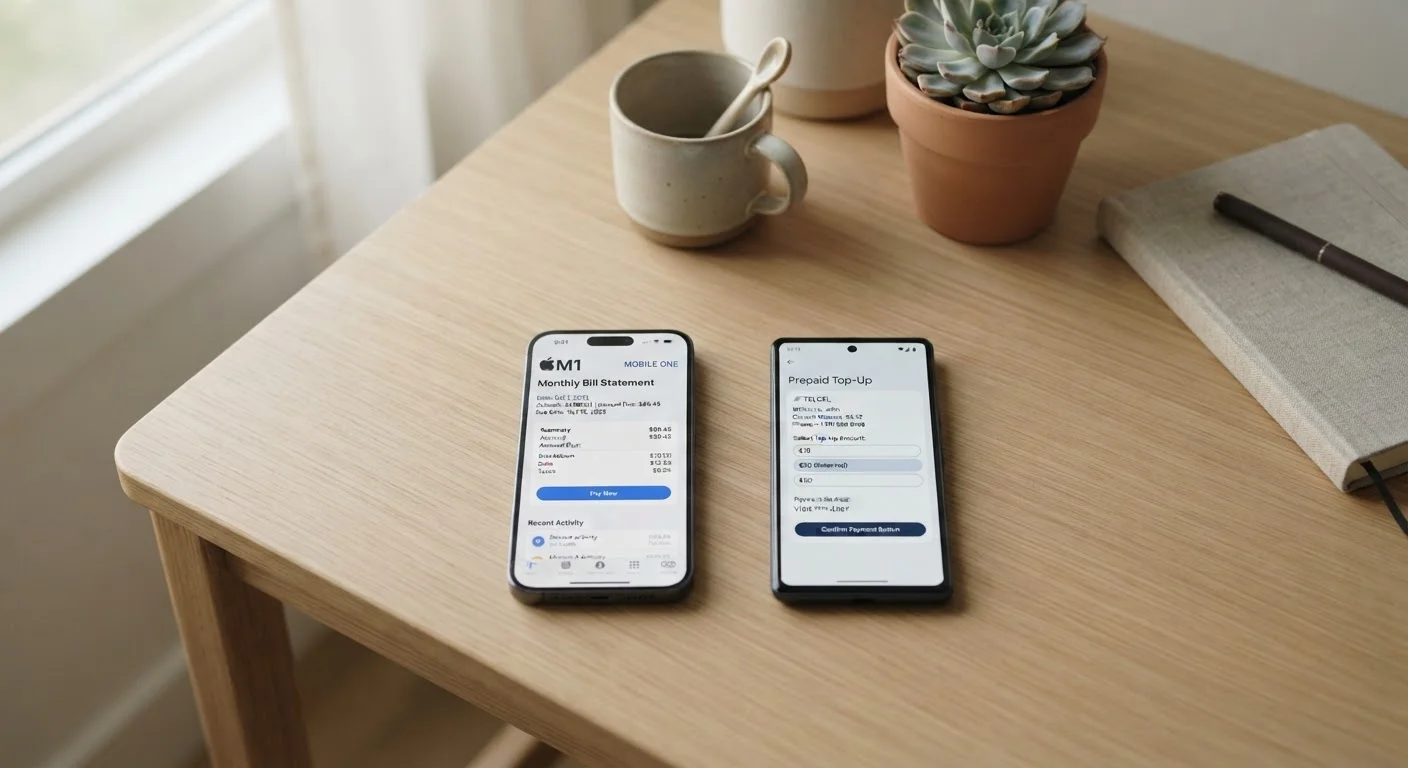
Key Takeaways
- Prepaid plans require payment before service; postpaid bills you after a monthly usage cycle.
- Prepaid plans carry no credit check or long-term contract obligations.
- Postpaid plans often offer better network priority and device installment financing.
- Hidden fees and taxes can affect both plan types - always compare the all-in monthly cost.
- Switching between plan types usually requires a new SIM or account, not just a settings change.
- Neither model is universally superior; the right choice depends on your usage habits and financial situation.
Option A
Prepaid Wireless
Pay upfront, use what you buy, no ongoing commitment.
Best for: Individuals who want cost predictability, flexibility, and no credit check requirements.
Option B
Postpaid Wireless
Use service now, pay at month's end with carrier credit.
Best for: Consumers who want premium device financing options, family plan discounts, and priority network access.
If you want no credit check and full billing predictability
Prepaid Wireless
Prepaid plans require no credit approval and cap your spending at whatever you load onto the account, eliminating surprise bills.
If you want to finance a flagship device through your carrier
Postpaid Wireless
Device installment plans and trade-in promotions are almost exclusively available on postpaid accounts, spreading the hardware cost over time.
If you travel internationally or only need occasional service
Prepaid Wireless
Many prepaid plans offer short-term or month-to-month options with no penalty for pausing, making them practical for irregular or travel-focused use.
If you're setting up a multi-line family account
Postpaid Wireless
Postpaid family plans typically unlock per-line discounts and centralized account management that prepaid accounts don't consistently offer.
How Each Billing Model Actually Works
The distinction between prepaid and postpaid wireless is fundamentally about when money changes hands and what that timing means for your service relationship with a carrier.
With prepaid wireless, you purchase a set amount of service - minutes, data, or a fixed plan period - before any usage occurs. When that balance or time period runs out, service pauses until you add more. There is no credit evaluation, no monthly contract, and no bill sent after the fact. You control how much you spend by deciding how much to load.
With postpaid wireless, the carrier extends you a line of credit: you use voice, text, and data throughout the billing cycle, and the carrier invoices you at cycle's end. This model mirrors how most utility bills work. Because the carrier is fronting service before receiving payment, it typically runs a credit check when you open an account. Missed payments can affect your credit report.
One point that surprises many consumers: network infrastructure is the same regardless of which model you choose. A postpaid plan on a given carrier uses the same towers as that carrier's prepaid offering. The difference lies in account structure, not signal quality - though priority during network congestion can vary, as explained below.
| Criterion | Prepaid | Postpaid |
|---|---|---|
| Payment timing | Before service begins | After monthly usage cycle |
| Credit check required | No | Typically yes |
| Contract or commitment | None | Month-to-month or device financing term |
| Network congestion priority | Lower (deprioritized) | Higher priority |
| Device installment financing | Rarely available | Widely available |
| Family plan per-line discounts | Limited | Common with multi-line accounts |
| Ease of switching or pausing | High flexibility | May involve financing balances |
| Bill predictability | Fixed upfront cost | Can vary with add-ons and fees |
Key Tradeoffs: Priority, Devices, and Flexibility
Beyond billing mechanics, prepaid and postpaid plans diverge in a few areas that affect day-to-day experience.
Network Priority
During periods of network congestion, carriers commonly give postpaid customers higher data priority than prepaid customers on the same towers. This means prepaid users may experience slower speeds in crowded areas - a tradeoff that matters most in dense cities or at large events. The Federal Communications Commission (FCC) has noted that deprioritization is a standard industry practice that should be disclosed in plan terms. Before signing up, it's worth checking those terms carefully. Our guide on reading a wireless plan before you commit walks through exactly what to look for.
Device Financing
Postpaid accounts are generally required to access carrier installment programs - the structured monthly payment arrangements that spread a smartphone's cost over 24 to 36 months. Prepaid customers typically must purchase a phone outright or use a prepaid-compatible unlocked device. If device financing matters to you, our breakdown of buying a phone outright vs. paying in installments covers what those payment structures actually cost.
Flexibility and Commitment
Prepaid plans can usually be changed, paused, or abandoned without penalty. Postpaid plans may include early termination fees or device financing balances that become due if you leave. That said, many carriers have shifted away from two-year service contracts, so the gap in flexibility has narrowed - but device financing agreements still create de facto lock-in.
~40%
U.S. wireless subscribers on prepaid plans
Industry analyst estimates have placed the prepaid share of U.S. wireless connections at roughly 40%, reflecting widespread adoption beyond low-income segments.
$10-$15
Typical monthly fee and tax additions per line
Consumer advocacy research suggests taxes and regulatory fees commonly add $10-$15 or more per line monthly on top of advertised plan prices.
What You're Really Paying: Fees on Both Sides
Advertised plan prices rarely reflect what you'll actually see on a bill. Both prepaid and postpaid plans are subject to federal, state, and local taxes as well as regulatory recovery fees - charges that can add anywhere from a few dollars to more than $10 per line per month depending on your location. For a detailed breakdown of where these extra costs come from, see our article on the hidden costs that inflate your monthly phone bill.
Postpaid bills can also include device installment charges, insurance premiums, and international add-ons that accumulate quickly. Prepaid plans are generally more transparent at the point of purchase because you're agreeing to a fixed dollar amount upfront - but even prepaid offerings can layer on taxes that reduce the actual service you receive per dollar loaded.
When comparing plans, always ask for the total monthly cost including all fees, not just the base rate. Carriers are required to disclose these charges, though they're not always prominent in marketing materials. If you're also evaluating your home internet bill under the same lens, the same principle applies - our guide to reading the fine print on your ISP contract explains how to decode those charges too.
Finally, if you're considering a multi-line household setup, postpaid family plans are worth examining closely - but so are the account-ownership implications. Family plans and how shared wireless accounts actually work is a useful next read before adding lines.