
Emergency Fund vs. Savings Account: What's the Difference and Do You Need Both?

Key Takeaways
- An emergency fund is money reserved exclusively for genuine financial emergencies, not routine expenses.
- A savings account is a bank product - your emergency fund is often held in one, but they are not the same concept.
- Most financial educators suggest targeting three to six months of essential living expenses in an emergency fund.
- You can use the same savings account for both purposes, but separating them reduces the risk of accidentally spending your safety net.
- Both serve distinct roles: one protects you from crisis, the other helps you build toward goals.
Option A
Emergency Fund
Your financial firewall against the unexpected.
Best for: Anyone who wants a dedicated cash buffer to cover unplanned expenses like job loss, medical bills, or urgent repairs without going into debt.
Option B
Savings Account
A flexible, interest-earning home for your money goals.
Best for: Savers who want a secure, accessible place to grow money toward planned goals - vacations, a home down payment, or a new car.
If you have no financial cushion and are starting from zero
Emergency Fund
Building even a small emergency fund first prevents a single unexpected expense from derailing your entire financial plan or forcing you into high-interest debt.
If your emergency fund is already fully funded
Savings Account
Once your safety net is in place, directing extra money into a goal-oriented savings account helps you make measurable progress on planned milestones.
If you want to automate and simplify your saving
Savings Account
A dedicated savings account - or multiple accounts labeled by purpose - makes it straightforward to automate contributions and track progress toward each goal separately.
If you are self-employed or have variable income
Emergency Fund
Income unpredictability makes a larger emergency fund especially important, since gaps between contracts or slow seasons can stretch for months.
Two Terms That Get Confused - and Why It Matters
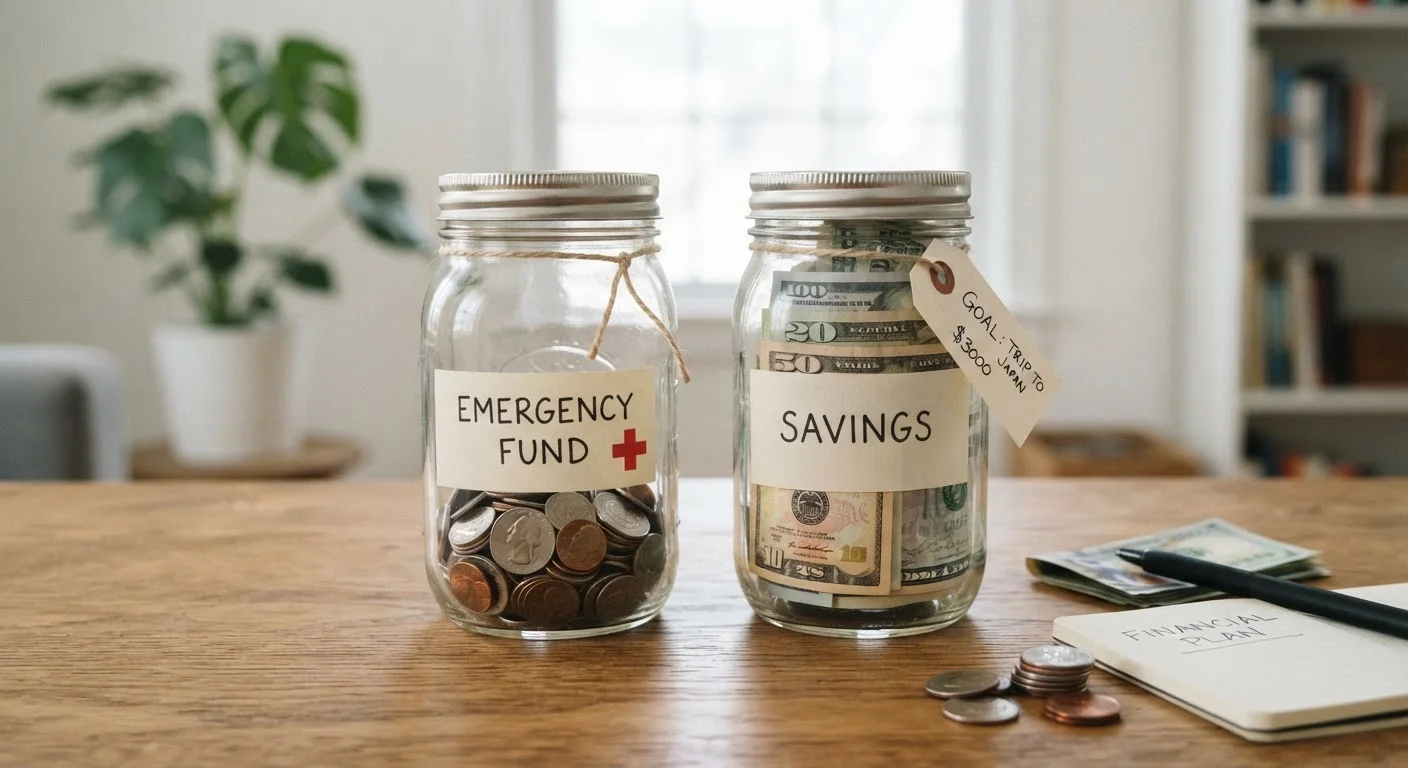
Many people use the phrases "emergency fund" and "savings account" interchangeably, but they describe two different things. A savings account is a financial product - a deposit account at a bank or credit union that earns interest and keeps your money accessible. An emergency fund is a purpose-defined pool of money set aside exclusively for genuine financial crises.
The confusion is understandable: your emergency fund is almost always kept in a savings account. But not everything in a savings account is an emergency fund. Conflating the two can lead to a costly habit - dipping into your safety net for non-emergencies and leaving yourself exposed when something serious goes wrong.
Understanding the distinction is a foundational step in building realistic savings habits. As part of a broader budgeting approach, it also connects directly to knowing your savings rate - a clear signal of overall financial health.
| Criterion | Emergency Fund | Savings Account |
|---|---|---|
| What it is | A purpose-defined cash reserve | A bank deposit product |
| Primary purpose | Cover financial emergencies only | Store and grow money toward goals |
| Typical target amount | 3-6 months of essential expenses | Whatever your goal requires |
| Access speed | Must be immediately accessible | Accessible, with possible transfer delays |
| Earns interest | Yes, when held in a savings account | Yes, at the account's stated rate |
| Risk level | Low - should never be invested | Low - FDIC/NCUA insured |
| Should it be separate? | Ideally, yes - to avoid misuse | Can hold multiple goal buckets |
What Defines an Emergency Fund
An emergency fund exists for one purpose: to cover essential living expenses or urgent costs when something goes unexpectedly wrong - a job loss, a medical emergency, a car breakdown that prevents you from working, or a sudden home repair. The defining features are liquidity (accessible quickly), stability (not subject to market risk), and intentionality (not used for anything outside a genuine emergency).
Financial educators commonly suggest targeting three to six months of essential living expenses - the costs you cannot avoid, such as rent, utilities, groceries, and insurance. People with variable income, dependents, or specialized careers may find that a larger cushion provides greater security. That said, even a modest starter fund of $500 to $1,000 can meaningfully reduce reliance on credit cards during a crisis.
~57%
Americans unable to cover a $1,000 emergency with savings
According to Bankrate's annual emergency savings report, a majority of U.S. adults would struggle to pay for a $1,000 unexpected expense from savings alone.
3-6 months
Recommended emergency fund target
Most mainstream personal finance guidance, including from nonprofit financial counseling organizations, points to three to six months of essential expenses as a sound baseline target.
Because an emergency fund is not meant to grow toward a goal - it is meant to sit and wait - it is often best held separately from your other savings. Keeping it in its own account, even at the same institution, reduces the temptation to treat it as general spending money.
How a Savings Account Fits Into the Picture
A savings account is the vehicle, not the destination. It earns interest on deposits, offers FDIC or NCUA insurance up to applicable limits, and keeps funds accessible without the risk exposure that comes with investing. Those features make it ideal for both an emergency fund and for goal-based saving.
Goal-based saving is what most people think of when they picture a "savings account" - setting aside money over time for a planned purchase or experience. A down payment fund, a travel fund, or a new-car fund all fit this description. For a closer look at how to build toward a specific target, see building a travel fund from scratch as a practical example of goal-based saving in action.
It is worth noting that savings accounts are not substitutes for investing. Money held in a savings account grows modestly and can lose real purchasing power to inflation over long periods. For goals that are years or decades away, a savings account alone may not be sufficient - a topic explored more fully in what investing actually means and why it's not the same as saving.
Do You Need Both - and Which Comes First?
Yes, most people benefit from having both a funded emergency reserve and a goal-oriented savings strategy - but they do not need to be funded simultaneously from day one. The practical question is sequencing.
For most households, building a basic emergency fund takes priority. Without one, any unexpected expense risks becoming a debt problem. Once a foundational buffer is established, additional savings contributions can be split between topping up the emergency fund and working toward specific goals.
The pay-yourself-first approach to saving is a useful framework here: automating a fixed transfer to your emergency fund at each pay period - before discretionary spending - removes the reliance on willpower and builds the habit gradually. Once your emergency fund reaches your target level, those automated contributions can be redirected toward your next financial goal.
For a broader framework that ties these concepts together, our complete guide to budgeting and saving walks through how to structure both within a realistic household budget.
This article is for general informational and educational purposes only and does not constitute personalized financial or investment advice. Consult a qualified financial professional before making decisions about your own financial situation.