

Key Takeaways
- A credit score is calculated from five weighted factors, with payment history carrying the most weight.
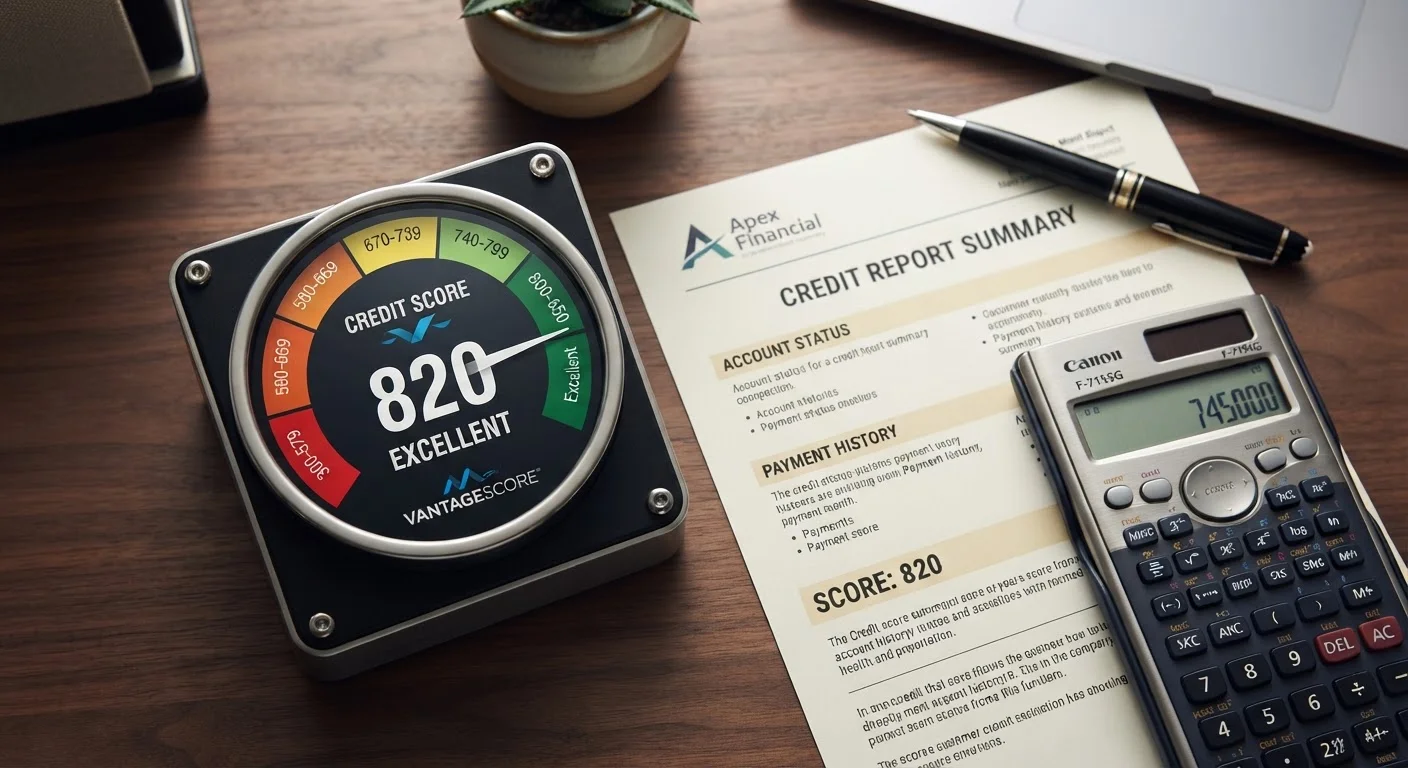
- Scores typically range from 300 to 850; most lenders consider 670 or above a good score.
- Your score is not fixed - it changes as your credit behavior changes.
- Multiple scoring models exist, so the score you see may differ slightly from what a lender sees.
- Improving your score takes consistent habits over time, not quick fixes.
Credit Score
A credit score is a three-digit number - typically ranging from 300 to 850 - that summarizes how reliably a person has managed borrowed money over time. Lenders use this number to quickly assess how likely a borrower is to repay a new loan or credit obligation. The higher the score, the lower the perceived risk to the lender.
The most widely used scoring model in the U.S. is the FICO® Score, though VantageScore is also commonly used. Different lenders may pull different versions of these scores, and each model weighs factors slightly differently.
What a Credit Score Actually Represents
A credit score is not a judgment of your worth or character - it is a statistical prediction. Specifically, it estimates the probability that a borrower will miss a payment by 90 or more days within the next 24 months. That narrow predictive purpose shapes everything about how scores are built.
Scores are generated by applying a mathematical model to the data in your credit report. That report - maintained by each of the three major credit bureaus - documents your borrowing history: accounts opened, balances carried, payments made or missed, and how long you've held credit relationships. If you're unfamiliar with how credit report data is structured, our guide to credit report terminology explains the key terms in plain language.
Because the score is derived from report data, it only reflects borrowing behavior. Income, savings, employment status, and net worth do not factor into a standard credit score - a reality that surprises many consumers.
The Five Factors That Build Your Score
Under the FICO® model, five categories of information contribute to your score, each weighted differently:
- Payment history (35%): Whether you've paid accounts on time. Even one late payment - particularly if it's 30 or more days past due - can significantly lower a score. This is the single largest factor.
- Amounts owed (30%): How much of your available credit you're using, often called your credit utilization ratio. Carrying high balances relative to your credit limits signals risk to lenders. See our deeper look at how credit utilization works for more detail.
- Length of credit history (15%): The age of your oldest account, your newest account, and the average age of all accounts. Longer histories generally support higher scores.
- Credit mix (10%): Whether you manage different types of credit - such as credit cards and installment loans - responsibly. Lenders view diversity as a sign of broader credit management experience. Installment loans and revolving credit affect your profile differently.
- New credit (10%): Recent applications for credit, reflected as hard inquiries. Multiple applications in a short window can suggest financial stress.
35%
Weight of payment history in FICO® score
According to FICO's published scoring factor breakdown, payment history is the single largest component of a standard credit score.
~59%
Americans with a 'good' score or higher
Data from Experian's State of Credit reports has consistently shown the majority of U.S. consumers fall in the 'good,' 'very good,' or 'exceptional' range.
300-850
Standard FICO® score range
The FICO® Score scale, the most commonly used consumer credit scoring model in the U.S., runs from a low of 300 to a high of 850.
Why Lenders Rely So Heavily on the Score
A lender approving hundreds of thousands of loan applications each year cannot manually evaluate every applicant's full financial story. Credit scores compress complex borrowing histories into a single, standardized, instantly comparable number. That efficiency has made scoring central to modern consumer lending.
The score also has a track record lenders trust. Credit scoring models are validated against actual default data - meaning the correlations between score ranges and repayment outcomes have been measured over decades and across millions of accounts. This doesn't guarantee any individual's behavior, but it gives lenders a reliable statistical baseline.
“Credit scoring has become the language lenders use to evaluate risk at scale. Understanding what goes into that number is one of the most practical things a consumer can do for their financial health.”
— Consumer Financial Protection Bureau, U.S. federal consumer financial regulatory agency
The practical consequence for consumers is significant. Your score influences not just whether you qualify for credit, but the interest rate you're offered, the credit limit extended, and even - in some cases - whether a landlord or employer proceeds with an application. A difference of even 50 score points can translate to meaningfully different loan terms.
This article is for general informational and educational purposes only. It is not personalized financial or credit advice. Consult a qualified financial professional for guidance specific to your situation.