

Key Takeaways
- Forced-air systems require more frequent upkeep, especially filter changes every 1-3 months.
- Radiant systems have fewer moving parts, meaning less routine maintenance but higher repair complexity.
- Annual professional inspections are advisable for both system types.
- Duct leakage in forced-air systems can silently reduce efficiency by up to 30%.
- Radiant hydronic systems need periodic fluid checks and pressure monitoring.
Our Verdict
Forced-air heating demands more frequent, hands-on homeowner maintenance-primarily filter changes and duct care-but repairs are generally more accessible and affordable. Radiant systems are largely low-maintenance day-to-day, yet their repairs are more specialized and costly when issues do arise. Neither system is inherently superior; the right choice depends on your home's setup and your comfort with routine upkeep.
| Best for | Recommended |
|---|---|
| Homeowners who prefer a DIY-friendly maintenance routine | Forced-Air |
| Those who want minimal ongoing upkeep and silent operation | Radiant Heat |
| Homes in climates requiring both heating and central air conditioning | Forced-Air |
| Homeowners prioritizing consistent, even warmth with long equipment lifespans | Radiant Heat |
How Each System Works
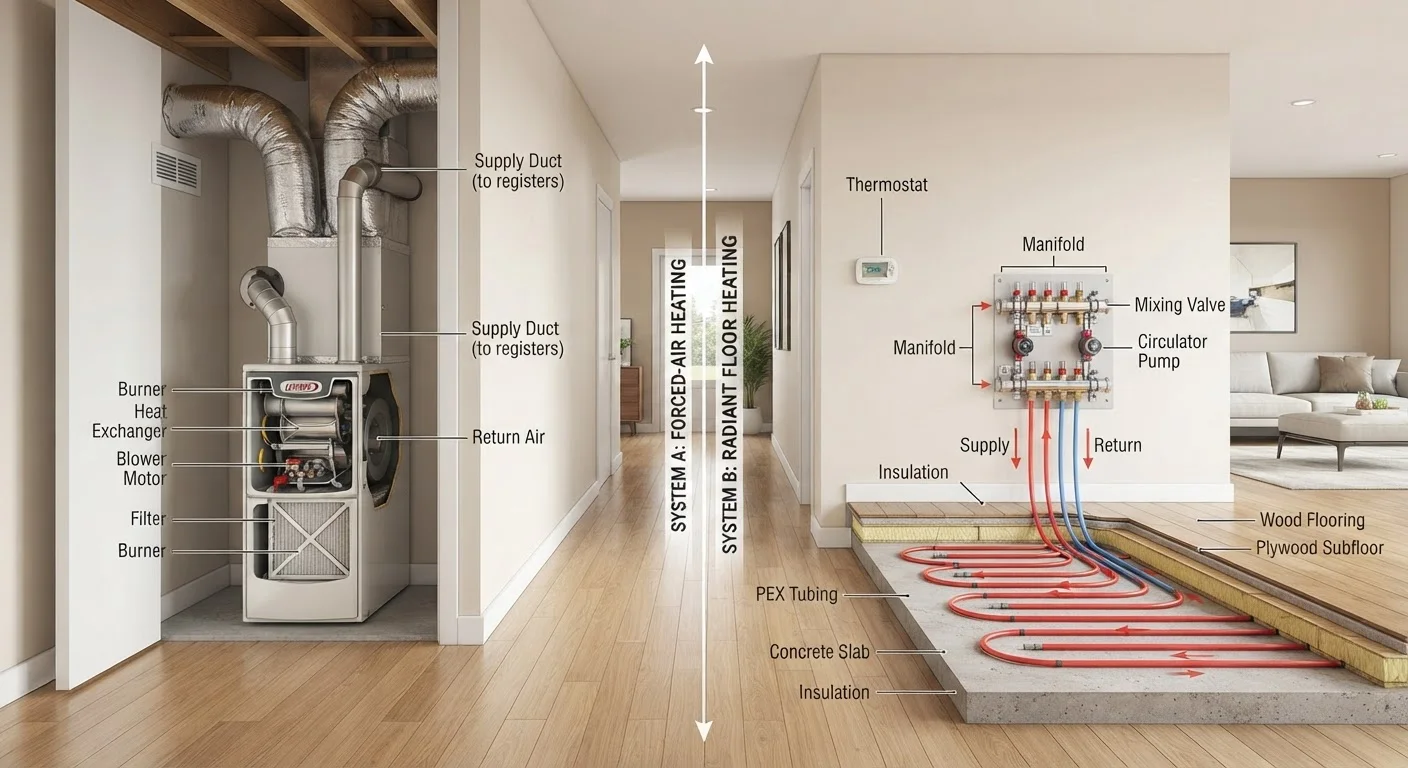
Understanding the maintenance gap between these two systems starts with knowing how they operate. Forced-air heating uses a furnace to heat air, then pushes it through a network of ducts and out through vents in each room. The system relies on a blower motor, a heat exchanger, a burner (gas or electric), and a filter-all components that can wear or get dirty over time.
Radiant heat warms surfaces directly rather than circulating air. Electric radiant systems use heating cables or mats beneath flooring. Hydronic systems-the more common type-pump heated water through tubing embedded in floors, walls, or baseboards. With no air movement and far fewer mechanical parts, radiant systems have a fundamentally quieter operating profile.
This difference in mechanics is the root cause of every maintenance difference explored below. See our complete home systems overview for context on how heating fits into your home's broader upkeep needs.
Forced-Air Maintenance: What the Routine Looks Like
Forced-air systems involve the most homeowner-facing maintenance of the two types. Here's what a responsible upkeep schedule includes:
- Filter replacement (every 1-3 months): This is the single most important DIY task. A clogged filter restricts airflow, overworks the blower motor, and degrades air quality. Thicker, high-MERV filters last longer but must match your system's airflow specs.
- Annual professional tune-up: A licensed HVAC technician should inspect the heat exchanger for cracks, check gas pressure, test safety controls, and clean the burner assembly. This is not a DIY task-cracked heat exchangers can allow carbon monoxide to enter the living space.
- Duct inspection and sealing: Leaky ducts are a hidden efficiency killer. The U.S. Department of Energy notes that duct leakage can account for significant heating losses in typical homes. Inspect accessible ductwork for disconnected joints or visible gaps, and use mastic sealant or metal-backed tape (not standard duct tape) on leaks.
- Vent and register cleaning: Vacuuming registers seasonally prevents dust buildup and keeps airflow even room to room.
For a deeper dive into duct and filter care, see our straightforward HVAC filter and duct guide.
| Forced-Air | Radiant Heat | |
|---|---|---|
| Filter maintenance | Every 1-3 months (DIY) | Not applicable |
| Annual professional service | Furnace tune-up required | Boiler or system inspection required |
| Duct/pipe maintenance | Duct sealing and cleaning needed | Minimal; hydronic pipes rarely need attention |
| DIY-friendliness | High - filters, registers are accessible | Low - most repairs need a specialist |
| Repair complexity | Moderate; parts widely available | High; may require flooring removal |
| Typical equipment lifespan | 15-20 years for furnace | 20-35 years for boiler and tubing |
| Air quality considerations | Filters essential; ducts can accumulate dust | No air circulation; no duct dust |
Radiant Heat Maintenance: Less Often, But More Specialized
Radiant systems reward homeowners with a notably lighter routine-but the tasks that do exist tend to require more expertise.
- Hydronic system fluid and pressure checks: Once or twice a year, check that system pressure falls within the manufacturer's specified range (typically 12-25 psi when cold). Low pressure often signals a leak or that the expansion tank needs servicing. Some systems use a glycol-water mixture as the heat transfer fluid, which must be tested periodically for proper concentration and pH.
- Boiler servicing: Hydronic systems are powered by a boiler, which needs an annual professional inspection covering the heat exchanger, burner, and safety relief valve. This is analogous to the annual furnace tune-up in a forced-air system.
- Electric radiant systems: These are nearly maintenance-free. There are no fluids, no pumps, and no moving parts-just heating elements beneath the floor. If a zone stops working, the fix typically involves a thermostat, a failed circuit breaker, or a damaged heating element, the last of which usually requires a professional.
- Thermostat and zone valve checks: Hydronic systems often use multiple zones with individual thermostats and motorized valves. Test each zone at the start of heating season to confirm it opens, closes, and responds correctly.
Bleed Hydronic Loops Before Winter
Air pockets trapped in hydronic tubing can cause uneven heating and put stress on the circulator pump. Before the heating season begins, use the bleed valves on each radiator or zone manifold to release any trapped air. Most systems have a simple manual bleed screw-consult your system's documentation or a licensed plumber if you're unfamiliar with the process.
Because radiant repairs often involve flooring removal or boiler components, costs when something does go wrong can be substantially higher than a typical forced-air fix. Factor that into your long-term planning.
Putting It All Together: Seasonal Upkeep Planning
Regardless of system type, the smartest maintenance approach is a calendar-driven one. Schedule filter checks for forced-air systems at the start of each season. Book boiler or furnace tune-ups in early fall before heating demand peaks. For radiant systems, bleed air from hydronic loops at the start of the heating season if zones feel unevenly warm-trapped air pockets are a common and easy-to-miss performance issue.
Homeowners managing either system will benefit from integrating heating maintenance into a broader annual routine. Our season-by-season home maintenance guide offers a practical framework for scheduling these tasks alongside roof, plumbing, and exterior care. Also worth checking: attic and crawl space upkeep, since poor insulation in these areas undermines the efficiency of both heating system types.
If you've absorbed some well-meaning but inaccurate upkeep advice over the years, it's worth reviewing common home maintenance myths before committing to a routine that could backfire.