

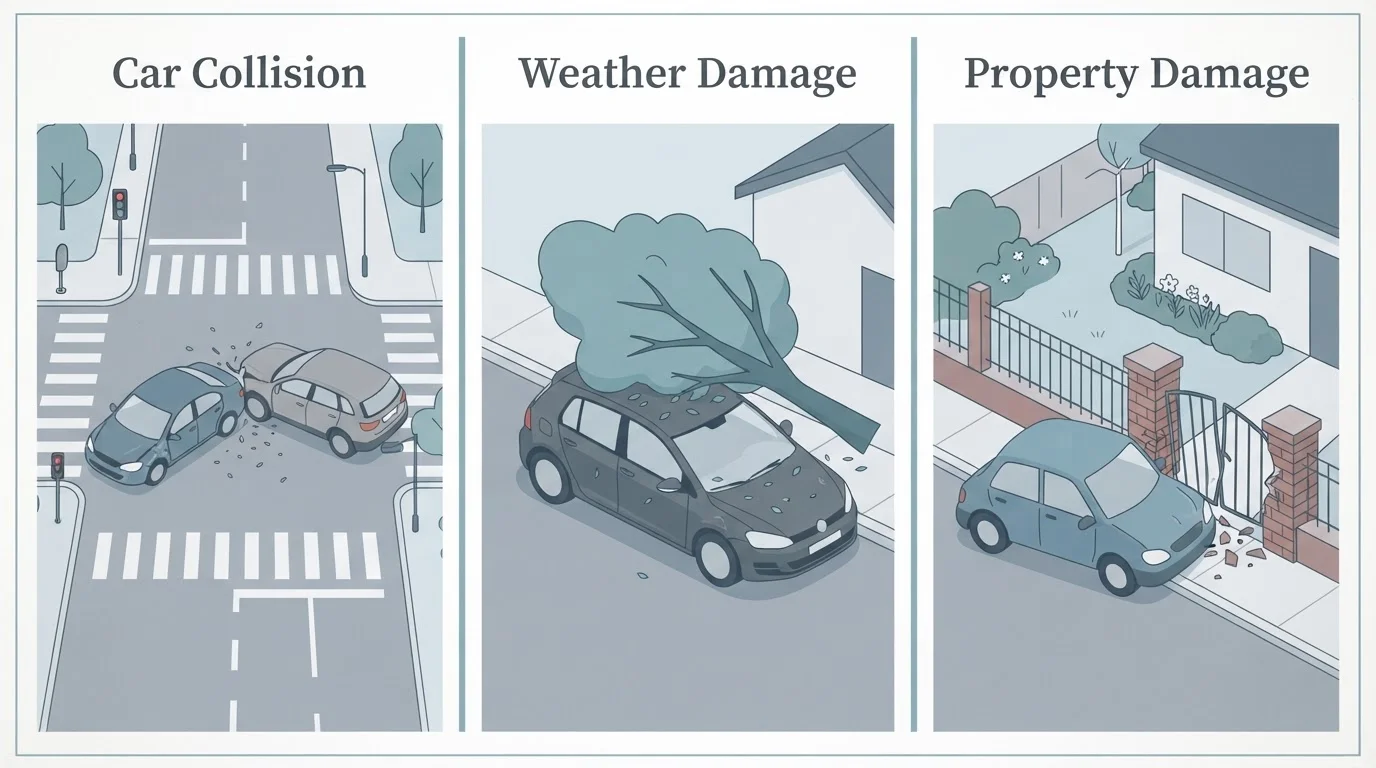
Key Takeaways
- Liability coverage pays for injuries and property damage you cause to others - not your own vehicle.
- Collision coverage pays to repair or replace your vehicle after it strikes another object, regardless of fault.
- Comprehensive coverage handles damage from events outside your control, such as weather, theft, or animals.
- Most lenders require both collision and comprehensive if you're financing or leasing a vehicle.
- No single coverage type protects against every scenario - understanding all three helps you identify gaps.
Auto Insurance Coverage Types
Auto insurance is typically made up of several distinct coverage types, each designed to pay for a different category of loss or damage. Liability, collision, and comprehensive are the three foundational coverages that form the backbone of most personal auto policies. Knowing what each one actually does - and doesn't do - is essential before you can evaluate whether your policy matches your needs.
In most states, liability coverage is legally required at minimum specified limits, while collision and comprehensive are optional unless required by a lender or lessor.
Liability Coverage: Protection for Others, Not Your Car
Liability coverage is the foundation of auto insurance and the only type required by law in most states. Despite how often it's discussed, many drivers misunderstand what it actually covers - and what it doesn't.
When you cause an accident, liability coverage pays for two categories of damage:
- Bodily injury liability: Medical expenses, lost wages, and pain-and-suffering claims for people you injure in a crash - including passengers in the other vehicle and pedestrians.
- Property damage liability: Repair or replacement costs for the other driver's vehicle, fences, buildings, or any other property you damage.
Critically, liability coverage does not pay for your own injuries or your own vehicle's damage. It exists solely to protect others from financial harm you cause. If your vehicle is totaled in an at-fault crash, you'd need collision coverage to address that loss.
Liability limits are expressed as three numbers - for example, 25/50/25. These represent (in thousands) the per-person bodily injury limit, the per-accident bodily injury limit, and the property damage limit. If damages exceed your limits, you're personally responsible for the difference. Many drivers find that state minimum limits provide less protection than they might expect. Common misconceptions about liability coverage are worth reviewing before assuming your current limits are adequate.
Check Your Liability Limits, Not Just Your Compliance
State minimum liability limits are set to ensure basic legal compliance, not to fully protect you financially. In a serious accident, damages can easily exceed minimums - leaving you personally liable for the gap. Review whether your limits reflect your actual financial exposure, and consider discussing higher limits with a licensed insurance agent.
Collision Coverage: Your Vehicle After an Impact
Collision coverage pays to repair or replace your vehicle when it's damaged in a collision - regardless of who caused the accident. The triggering event must involve your vehicle physically striking something: another car, a guardrail, a telephone pole, or even a pothole in some policy definitions.
Key points about collision coverage:
- It applies whether you are at fault, partially at fault, or not at fault at all.
- If the other driver is at fault and has adequate insurance, their liability coverage would typically pay for your repairs - but collision can step in if the other driver is uninsured or if fault is disputed.
- Collision coverage pays up to your vehicle's actual cash value (ACV), minus your deductible. ACV reflects the market value of your vehicle at the time of loss, accounting for depreciation - not the original purchase price.
Lenders and leasing companies almost universally require collision coverage when you're financing or leasing a vehicle. Once you own the vehicle outright, it becomes optional. For a closer look at how collision and comprehensive compare in real scenarios, see our side-by-side breakdown.
~75%
U.S. drivers carrying collision coverage
According to the Insurance Information Institute, roughly three-quarters of insured U.S. drivers include collision coverage on their policies.
~80%
U.S. drivers carrying comprehensive coverage
The Insurance Information Institute also reports that comprehensive coverage is slightly more common than collision among insured American drivers.
1 in 8
Drivers estimated to be uninsured on U.S. roads
The Insurance Research Council has estimated that approximately one in eight drivers on U.S. roads carries no auto insurance, underscoring why liability limits and supplemental coverages matter.
Comprehensive Coverage: Events Outside Your Control
Comprehensive coverage - sometimes called "other than collision" - handles damage to your vehicle from events that aren't a collision with another object. Think of it as protection for things that happen to your car rather than things you do with your car.
Common events covered under comprehensive:
- Theft of the vehicle
- Vandalism
- Weather events: hail, flooding, wind damage, ice
- Fire
- Falling objects (tree limbs, debris)
- Animal strikes (hitting a deer is one of the most common comprehensive claims in many states)
Like collision, comprehensive pays up to your vehicle's actual cash value minus your deductible. Deductibles are chosen when you set up the policy and can typically range from a few hundred dollars to over a thousand - higher deductibles reduce your premium but increase what you pay at claim time.
One point that surprises many drivers: if a tree falls on your parked car, that's a comprehensive claim, not a collision claim - because your vehicle wasn't moving or striking anything. Understanding this distinction matters when reviewing your policy. Reading your policy document carefully can reveal exactly which events are covered and which are excluded.
How the Three Work Together - and Where Gaps Can Appear
Most personal auto policies bundle these three coverage types, but it's a mistake to assume they collectively cover every situation. Each one addresses a defined category of risk, and there are real scenarios where none of the three apply.
For example, if an uninsured driver rear-ends you, their liability coverage doesn't exist - and your own liability coverage won't help because you didn't cause the accident. Collision coverage could pay for your vehicle's damage, but your medical expenses would fall to a separate coverage type: uninsured motorist coverage or medical payments coverage. Our guide on uninsured and underinsured motorist coverage explains how this protection works and why it matters.
A simplified view of how the three core coverages divide responsibilities:
| Coverage | What It Pays For | Required by Law? |
|---|---|---|
| Liability | Damage/injuries you cause to others | Yes, in most states |
| Collision | Your vehicle after an impact | No (unless lender requires) |
| Comprehensive | Your vehicle from non-collision events | No (unless lender requires) |
Understanding these three types clearly is the first step - but a complete picture of your coverage requires reviewing your full policy for exclusions, limits, and any add-ons you've selected or may need. This article is for general educational purposes only and does not constitute personalized insurance advice. Coverage terms, limits, and availability vary by provider and state; consult a licensed insurance professional for guidance specific to your situation.
Coverage Terms Vary by Policy and State
The descriptions of liability, collision, and comprehensive coverage in this article reflect general industry standards. Actual policy language, exclusions, and available limits differ by insurer and by state. Always read your policy declarations page and coverage sections carefully, and consult a licensed insurance professional if you have questions about your specific policy.