

Key Takeaways
- Packing a day early eliminates last-minute scrambling and reveals forgotten essentials before it's too late.
- A master packing list tailored to trip type saves time on every future trip you take.
- Choosing carry-on only can eliminate checked-bag fees and baggage-claim wait times entirely.
- Packing cubes and a consistent organization system make unpacking at home almost effortless.
- Wearing your bulkiest items on travel days frees significant luggage space without extra cost.
Why Packing Deserves More Planning Than It Usually Gets
Most travel stress doesn't start at the airport - it starts the night before, when you're staring at an open suitcase trying to remember if you packed your phone charger. Packing is one of the most overlooked parts of trip planning, yet poor decisions made at home ripple across every stage of travel: overweight bag fees at check-in, frantic searching mid-trip, and exhausted repacking on the last night of a vacation you were supposed to enjoy.
The good news is that a few structural changes to how you approach packing can eliminate most of that friction. These strategies work whether you're flying carry-on only for a long weekend or checking a bag for a two-week international trip. They're also one of the more direct ways to keep costs down - part of a broader budget-conscious approach to travel planning that starts long before you reach the terminal.
Build a reusable master packing list
A master list is a living document - not a checklist you recreate from scratch each trip. Start with the non-negotiables (ID, medications, chargers, toiletries) and add a separate section for trip-specific categories: beach trip, cold-weather travel, international, business. Store it somewhere accessible (a notes app works well) and refine it after every trip. The first time you return home and realize you brought something you never touched, remove it from the list.
This approach takes about 20 minutes to set up and saves that much time on every trip afterward. It also prevents the specific anxiety of wondering mid-flight whether you forgot something - because you checked a list.
A master packing list refined over time is one of the highest-return investments a traveler can make.
Pack at least 24 hours before departure
Packing the night before a morning flight under pressure is a reliable way to forget things and overpack simultaneously. Packing a full day early gives you time to notice gaps, swap out items that don't actually fit together as outfits, and run a final laundry cycle if needed. It also gives you time to weigh your bag if checked-bag weight limits are a concern.
Keep a small basket or designated spot where you can set aside items to pack as you think of them in the days leading up to departure. The bag itself goes in last once everything is gathered.
Packing 24 hours early creates a buffer to catch gaps before the cab arrives.
Challenge every item with a simple test
Before anything goes in the bag, ask two questions: Will I wear or use this at least twice? Can I get it easily at my destination if I truly need it? Items that fail both questions usually don't need to make the trip. This matters most for bulky items - a second pair of dress shoes, a heavy jacket "just in case," or a book you'll probably never open.
The goal isn't to pack as little as possible - it's to pack only what earns its weight. Travelers who master this consistently avoid checked-bag fees, a straightforward win covered in more detail in our guide to lesser-known ways travelers cut costs.
Every item in your bag should earn its spot - if it fails a simple use-test, leave it behind.
Use packing cubes to create a consistent internal system
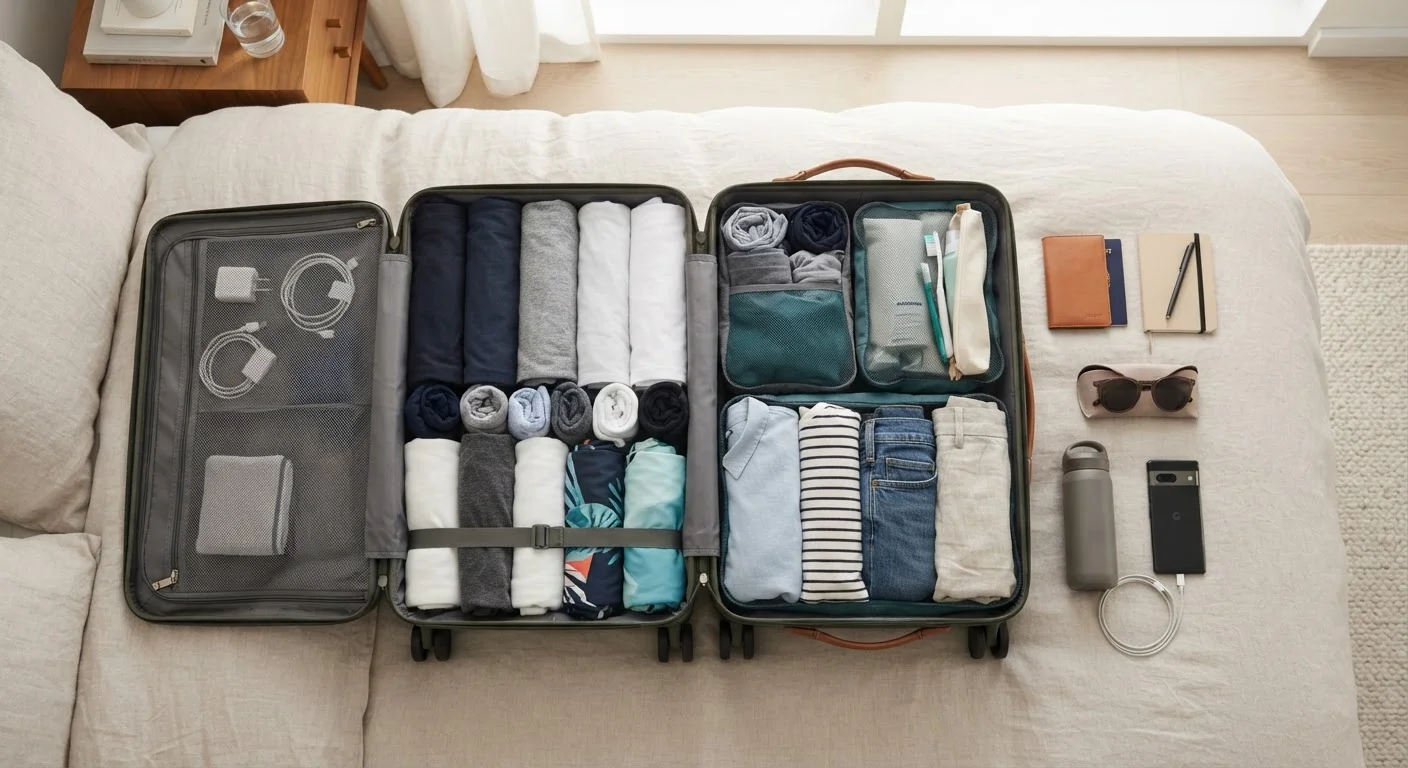
Packing cubes are fabric organizers that compress clothing into defined zones inside your bag. Their real value isn't compression - it's consistency. When tops always go in one cube, bottoms in another, and accessories in a third, you always know where everything is. That means faster security unpacking, faster hotel room settling, and dramatically faster repacking at the end of the trip.
They also make laundry management cleaner: a separate cube or dry-sack for worn clothing prevents it from mixing with clean items. This is a small detail that matters a lot on trips longer than five days.
Packing cubes create a system you can use consistently, making every future trip easier to pack.
Wear your bulkiest items on travel days
Boots, heavy jackets, and thick sweaters take up disproportionate bag space relative to their weight. On travel days - when you're moving through airports rather than sightseeing - wearing these items onto the plane costs nothing and frees significant room in your bag. This is especially useful for winter travel or ski trips where cold-weather gear is unavoidable.
If you're flying carry-on only, this strategy can be the difference between fitting within size limits and having to gate-check. It also helps on the return trip when souvenirs or purchases are taking up room you didn't originally need.
Wearing bulky layers on travel day is one of the simplest ways to reclaim bag space for free.
Plan outfits, not individual garments
Packing individual clothing items without checking they work together is how travelers end up with two pairs of pants that don't match any of their shirts. Before packing, lay out complete outfit combinations - top, bottom, shoes, layer - for each day of the trip. You'll quickly identify redundancies and gaps. A neutral color palette helps here; items that mix and match easily reduce the total number of garments needed.
If your itinerary includes a range of activities - a beach day, a nice dinner, a hiking morning - plan specific outfits for each rather than packing "options." This pairs naturally with the pre-trip planning habits that reduce stress at every stage of travel.
Planning complete outfits before packing eliminates redundant garments and prevents the 'nothing matches' problem.
Standardize your toiletry kit and keep it travel-ready
Repacking toiletries from scratch before every trip - transferring products into travel-size containers, remembering what you used last time - adds unnecessary friction. A dedicated travel toiletry bag stocked with travel-size versions of your essentials and kept packed between trips removes that friction entirely. After returning, restock anything that ran out, and the kit is ready for next time.
Be realistic about what you'll actually use. Many travelers pack a full skincare routine but only ever use moisturizer and sunscreen on the road. A streamlined kit also keeps you within TSA liquid rules for carry-on travel without any last-minute reorganizing at security.
A permanently packed toiletry kit removes one of the most repetitive and forgettable steps before any trip.
Making the Return Trip as Easy as the Departure
Most packing advice focuses exclusively on leaving home. But the return trip - tired, possibly carrying souvenirs, facing a early-morning flight - is when disorganization really bites. A few of the strategies above (especially the master list and packing cubes) pay their biggest dividends on the way home, when you're repacking in a hurry with less energy than you had at the start.
Photograph Your Packed Bag Before Leaving
Before zipping up, take a quick photo of your bag's contents. If you're ever unsure mid-trip whether you packed something - or need to remember what to reclaim at a hotel - the photo gives you a clear reference. It takes five seconds and has saved more than a few travelers from a panicked search.
If you consistently over-pack, it may also be worth revisiting how your trip is structured. Overscheduled itineraries often drive over-packing - when you don't know exactly what you'll be doing each day, you hedge by bringing options. Our guide on why rigid itineraries fail explores how more flexible planning can actually simplify decisions like this one. Smarter packing and smarter planning tend to reinforce each other.