

Key Takeaways
- Hostels typically offer the lowest nightly price per person, especially in dorm-style rooms.
- Budget hotels win on consistency and privacy for solo travelers or couples needing simplicity.
- Vacation rentals often become cost-effective only when shared among three or more people.
- Hidden fees - cleaning charges, resort fees, city taxes - can meaningfully shift the true cost of any option.
- Your trip length, group size, and destination all determine which lodging type genuinely saves the most.
Our Verdict
No single lodging type wins for every traveler. Hostels cut costs furthest for solo travelers and social adventurers. Budget hotels offer reliable value for couples or short stays where predictability matters. Vacation rentals deliver real savings mainly when costs are split across a group and the stay is long enough to absorb upfront fees.
| Best for | Recommended |
|---|---|
| Solo travelers or those comfortable in shared spaces | Hostel |
| Couples or solo travelers prioritizing privacy and simplicity | Budget Hotel |
| Groups of three or more, or stays of five or more nights | Vacation Rental |
| Families needing kitchen access and extra living space | Vacation Rental |
How Each Lodging Type Is Priced
Understanding the pricing structure of each option is the first step toward knowing which will actually save you money. Price tags alone rarely tell the full story - as our guide on hidden costs inside cheap travel deals explains.
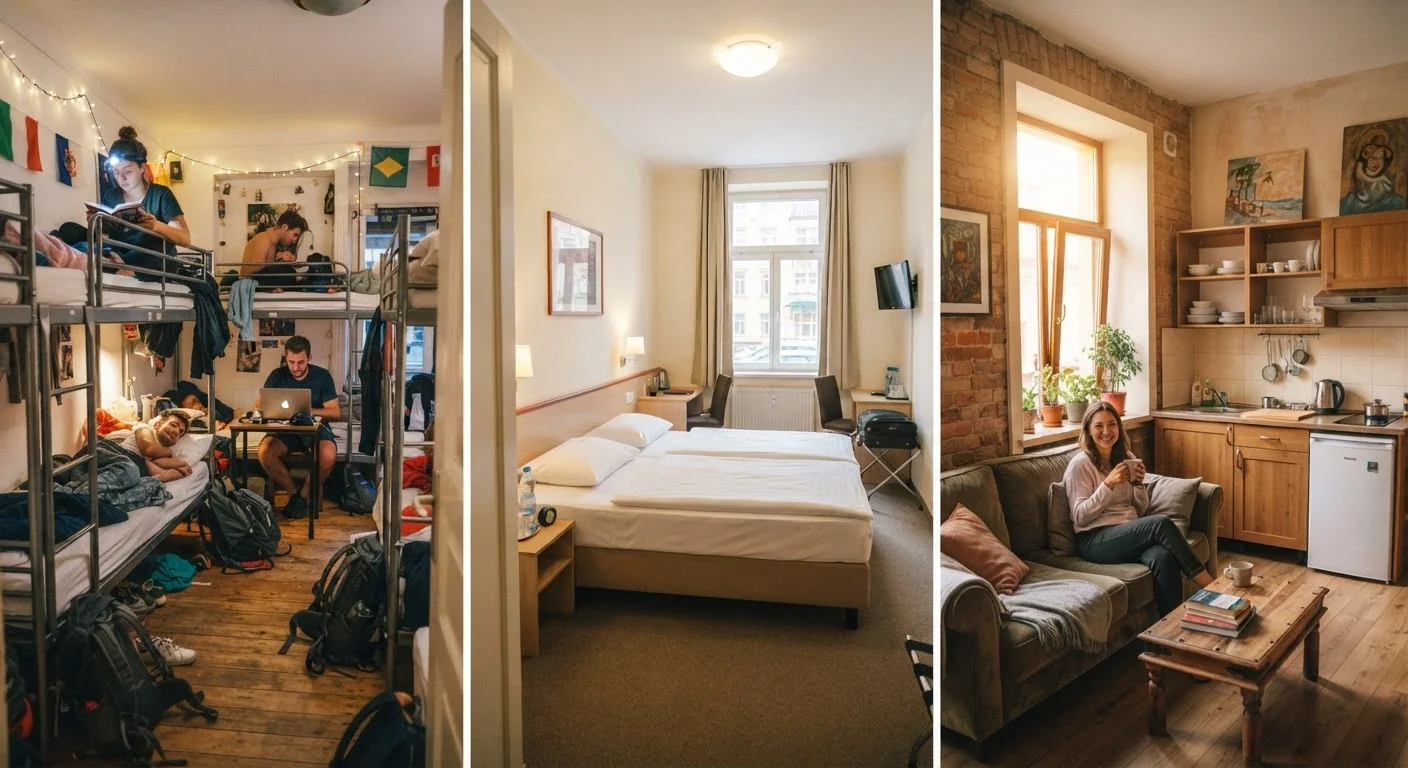
Hostels charge per bed, not per room. A dorm bunk in a popular city can run $20-$45 per person per night, while private hostel rooms - a single enclosed room within the hostel - typically cost $60-$110 and strip away most of the savings advantage. The dorm rate is the real budget lever.
Budget hotels charge per room. A modest room in the U.S. or Western Europe might run $70-$130 nightly. For a solo traveler, that's steep compared to a dorm. For two people splitting it, the per-person rate drops into competitive range.
Vacation rentals carry a nightly rate plus a cleaning fee that often runs $50-$150 regardless of stay length. A three-night stay that looks affordable per night may look less so once that flat fee is spread across just a few days. Longer stays and more people sharing the cost change the math significantly.
| Hostel (Dorm) | Budget Hotel | Vacation Rental | |
|---|---|---|---|
| Typical cost per person/night | $20-$45 | $35-$65 (shared) | $25-$60 (group of 4) |
| Privacy level | Low - shared room | High - private room | High - private space |
| Kitchen access | Communal kitchen | Rarely available | Full private kitchen |
| Best group size | Solo or 2 | 1-2 people | 3 or more |
| Ideal stay length | 1-7 nights | 1-3 nights | 4+ nights |
| Upfront hidden fees | Low | Low to moderate | Cleaning fee often $50-$150 |
| Cancellation flexibility | Varies by property | Often flexible | Often stricter |
Privacy, Comfort, and What You're Actually Paying For
Cost is only part of the equation. What each lodging type delivers in exchange for that cost matters just as much - especially when a poor night's sleep or a missing kitchen throws off the whole trip.
Hostels offer the least privacy by design. Shared bathrooms, common kitchens, and bunk room noise are standard. The trade-off is a built-in social environment that many solo travelers find genuinely valuable - and access to communal kitchens that can dramatically lower food costs.
Budget hotels provide a private room, a private bathroom, and little else. Amenities are minimal - expect a bed, a TV, and basic toiletries - but the consistency is real. You know what you're getting. For travelers who value predictable sleep quality over social interaction, this reliability has measurable worth.
Vacation rentals offer the most space and the most home-like experience. A kitchen lets you cook, which cuts meal costs. A living room allows groups to gather without paying for restaurant seating. For families or groups, this spatial value is substantial. For solo travelers, it's often wasted square footage.
Use the Kitchen to Compound Your Savings
Both hostels and vacation rentals typically offer kitchen access - a feature worth factoring into your true lodging cost. Cooking even one meal per day in a shared or private kitchen can reduce daily food expenses by $15-$30 per person. Over a week-long trip, that adds up to meaningful savings that don't show up in the nightly rate comparison but are just as real.
When Group Size and Trip Length Flip the Calculation
The lodging type that saves the most shifts considerably based on how many people are traveling and for how long. This is the factor most travelers underweight when comparing options.
A solo traveler spending five nights in Lisbon will almost certainly spend less in a hostel dorm than in any private room. A family of four spending the same five nights will likely find a vacation rental cheaper per person than four hotel beds - and far more functional than a cramped budget room.
Vacation rental cleaning fees are a real barrier for short stays. On a two-night trip, a $120 cleaning fee adds $60 per night to your effective cost before you factor in the nightly rate. Stretch that same fee across seven nights, and it adds under $18 per night - a much easier number to absorb. As part of a broader approach to managing travel expenses, this kind of fee-awareness is covered in our field-tested budget stretching strategies.
Budget hotels tend to be most cost-competitive on one- to three-night stays, particularly for two travelers. The per-night rate is predictable, there are rarely surprise fees, and the trade-off on space is manageable for a short visit.
Practical Factors That Affect Real-World Fit
Beyond raw dollars, a few practical realities shape which option works best for a given trip.
- Location: Hostels are heavily concentrated in walkable urban cores and popular backpacker destinations. In rural areas or smaller U.S. cities, the hostel option may simply not exist, making budget hotels or vacation rentals the default.
- Booking flexibility: Budget hotels often allow free cancellation closer to the travel date. Many vacation rentals have stricter cancellation policies, and some hostels require deposits. If your plans are uncertain, flexibility has tangible financial value.
- Safety and storage: Hostels typically offer lockers, but valuables require active management in a shared-room environment. Vacation rentals and hotels provide more inherent security for belongings.
- Tax and fee transparency: All three lodging types can carry city occupancy taxes, tourism levies, or platform service fees that aren't always visible at the search stage. Always review the total checkout price before assuming a rate is what you'll pay.
For a broader framework on estimating what lodging will truly cost within your overall travel plan, see our guide to building a travel budget that actually holds up.