

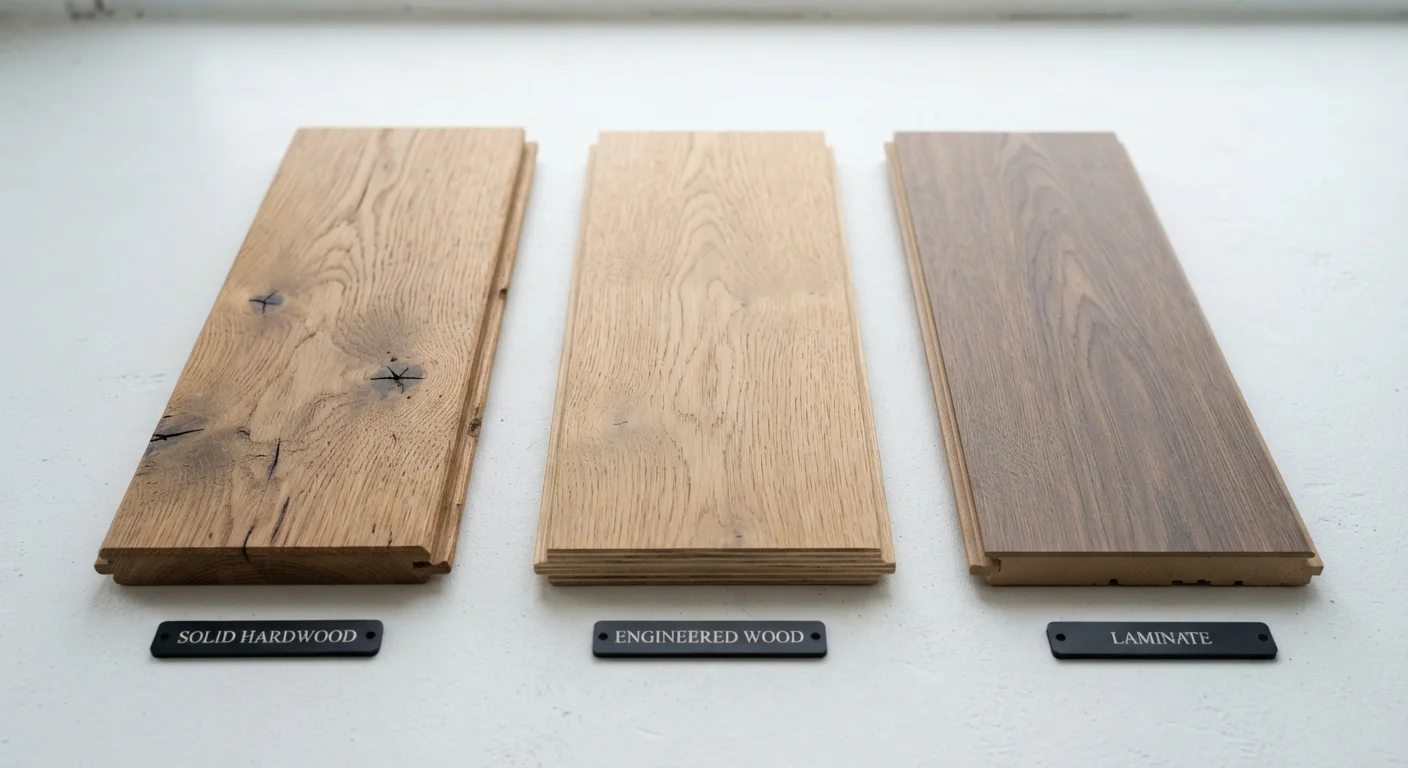
Key Takeaways
- Solid hardwood offers the longest lifespan but is the most expensive and moisture-sensitive option.
- Engineered wood handles humidity better than solid hardwood and can be refinished at least once.
- Laminate is the most budget-friendly choice but cannot be refinished and may feel less premium underfoot.
- Moisture levels in your home and subfloor type are the two most critical factors when choosing a floor.
- Installation method and difficulty vary significantly across all three types.
Our Verdict
All three flooring types can serve a home well when matched to the right conditions. Solid hardwood rewards long-term investment in dry, above-grade spaces. Engineered wood threads the needle between authenticity and resilience, making it the most versatile of the three. Laminate suits cost-conscious projects or high-traffic areas where surface wear is a constant concern.
| Best for | Recommended |
|---|---|
| Homeowners seeking long-term investment value in low-humidity rooms | Solid Hardwood |
| Those wanting real wood appearance in kitchens, basements, or humid climates | Engineered Wood |
| Budget-conscious renovators or renters updating high-traffic spaces | Laminate |
| DIYers prioritizing the simplest, fastest installation | Laminate |
What Sets Each Flooring Type Apart
Understanding what each flooring type is made of explains most of the performance differences you'll encounter. Solid hardwood is milled from a single piece of wood, typically ¾ inch thick, giving it the real-wood character and refinishability that makes it so valued. Engineered wood uses a genuine hardwood veneer bonded over several layers of plywood or high-density fiberboard - a construction that resists seasonal expansion and contraction far better than solid wood. Laminate contains no real wood at all; instead, a photographic layer printed to mimic wood grain sits beneath a hard protective coating over a composite core.
These structural differences cascade into nearly every practical consideration: how each floor feels underfoot, where it can be installed, how long it lasts, and what happens when it's damaged.
| Solid Hardwood | Engineered Wood | Laminate | |
|---|---|---|---|
| Material composition | Single solid wood plank | Hardwood veneer over plywood core | Printed layer over composite core |
| Typical lifespan | 50-100+ years | 25-50 years | 15-25 years |
| Moisture tolerance | Low - prone to warping | Moderate - resists movement | Low to moderate - core can swell |
| Can be refinished | Yes - multiple times | Yes - once or twice | No |
| DIY installation difficulty | Difficult | Moderate | Easy |
| Relative material cost | Highest | Mid-range | Lowest |
| Below-grade suitability | Not recommended | Often suitable | Often suitable |
Durability and Moisture Tolerance
Solid hardwood is genuinely durable - properly maintained floors can last 100 years or more - but wood expands and contracts with humidity changes. This makes solid hardwood a poor choice for below-grade spaces like basements, and a risky one for kitchens and bathrooms without careful moisture management. Cupping, warping, and gapping are real risks when humidity swings widely.
Engineered wood's layered construction reduces that movement dramatically. Most engineered products carry a moisture-tolerance advantage over solid wood, though they're still not waterproof. Standing water left unaddressed will cause damage. The hardwood veneer can typically be lightly sanded and refinished once or twice depending on its thickness - thinner veneers (2mm or less) may only tolerate a single pass.
Laminate's composite core absorbs water more readily than it appears, making prolonged moisture exposure its primary vulnerability. Many modern laminate products include water-resistant or waterproof cores, so checking a product's specific moisture rating before installation in wet-prone rooms is worth doing. Laminate cannot be refinished; when the surface layer wears through, replacement is the only option.
Don't Skip a Moisture Test
Before installing any flooring over a concrete subfloor or in a below-grade space, test for moisture using a calcium chloride or relative humidity test. Elevated moisture levels can ruin a floor installation within months. Many flooring manufacturers specify acceptable moisture thresholds in their warranty documentation - exceeding those limits typically voids coverage.
Installation and Subfloor Compatibility
Solid hardwood is typically nailed or stapled to a wood subfloor and requires a subfloor that is level and structurally sound. It cannot be installed below grade and generally needs professional installation for best results - improper installation voids most manufacturer warranties.
Engineered wood offers more flexibility. It can be glued down, nailed, or floated (where planks click together without adhesive or fasteners) depending on the product. This makes it compatible with concrete subfloors and suitable for basement installations in many cases, though you should always verify with the manufacturer's guidelines.
Laminate is the friendliest option for DIY installation. Most laminate uses a click-lock floating system that requires no adhesive and can go directly over many existing floors, including tile and vinyl, as long as the subfloor is level. This also makes it easier to remove if you change your mind later.
Always Acclimate Before Installation
Both solid and engineered hardwood should be left in the room where they'll be installed for at least 48-72 hours before laying. This allows the planks to adjust to the room's temperature and humidity, reducing the risk of gaps or buckling after installation. Laminate benefits from acclimation as well, though its composite core is less sensitive.
Cost Considerations
Flooring costs vary widely based on species, grade, finish, and region, so these are general ranges rather than firm prices. As a category, solid hardwood carries the highest material cost and typically the highest installation cost given the labor involved. Engineered wood generally falls in the middle range - more affordable than solid hardwood, though premium engineered products with thick veneers and exotic species can approach solid wood pricing. Laminate sits at the lower end of the cost spectrum for both material and installation, particularly when a homeowner installs it themselves.
Beyond purchase price, it's worth factoring in longevity. A solid hardwood floor that can be refinished multiple times over 50 years may represent better value than replacing laminate every 15-20 years, depending on how long you plan to stay in the home. Labor costs for refinishing are meaningful, but they're generally less than full replacement.