

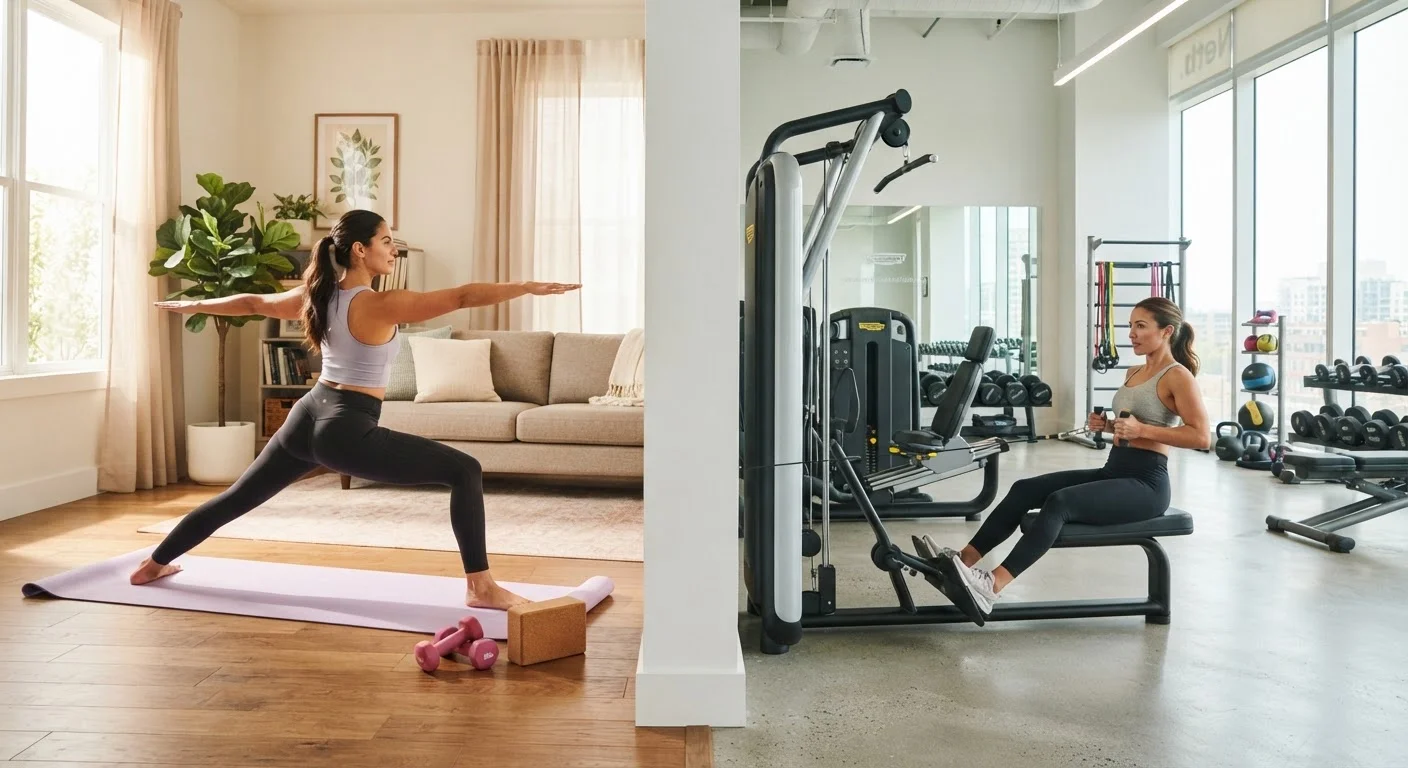
Key Takeaways
- Home workouts eliminate commute time and membership costs, making consistency easier for busy schedules.
- Gyms offer equipment variety, professional guidance, and a structured environment that some people find motivating.
- Neither option is universally superior - long-term adherence matters more than the setting itself.
- A hybrid approach, combining both environments, works well for many people at different fitness levels.
- Consult a healthcare professional before starting a new exercise program, especially with existing health conditions.
Our Verdict
Home workouts and gym sessions each have genuine strengths and real limitations. The setting that produces better results is almost always the one you'll actually stick with consistently. Rather than searching for a universal winner, focus on which environment removes the most barriers for your life right now.
| Best for | Recommended |
|---|---|
| Those working within tight budgets or unpredictable schedules | Home Workouts |
| People who benefit from structured environments, social motivation, or specialized equipment | Gym Sessions |
| Beginners who want variety and professional guidance early on | Gym Sessions |
| Experienced exercisers who value flexibility and have some basic equipment | Home Workouts |
The Real Question Isn't Which Is Better
The home-versus-gym debate tends to frame exercise as a logistics problem with one correct answer. In reality, movement science is pretty clear on something more fundamental: consistency matters far more than location. A well-designed bodyweight routine done reliably at home will outperform an expensive gym membership you rarely use.
That said, the two settings genuinely differ across several practical dimensions - cost, equipment access, social environment, and flexibility - and understanding those differences can help you build a routine that actually fits your life. If you're also curious about how different types of exercise affect your body, our guide to cardio vs. strength training walks through the distinct physiological effects of each.
| Home Workouts | Gym Sessions | |
|---|---|---|
| Typical monthly cost | Low to none (after initial setup) | Varies widely ($10-$100+) |
| Equipment variety | Limited unless heavily invested | Broad range available |
| Commute required | None | Yes - time and travel cost |
| Progressive overload ease | Requires more creativity | Straightforward with available weights |
| Social motivation | Minimal by default | Often present |
| Schedule flexibility | Very high | Depends on gym hours and crowds |
| Expert guidance access | Limited (online resources) | In-person trainers available |
Cost and Accessibility
Gym memberships in the U.S. vary widely - from budget facilities charging around $10-$30 per month to full-service clubs exceeding $100 monthly, not counting initiation fees or class add-ons. Over a year, that adds up meaningfully, especially for households managing tight budgets.
Home workouts can require little to no upfront investment. Bodyweight exercises - push-ups, squats, lunges, planks - need no equipment at all. Resistance bands and a set of adjustable dumbbells represent modest one-time costs that can support a broad range of training goals. The tradeoff is that duplicating a full gym's equipment variety at home becomes expensive quickly if you want to go beyond the basics.
Accessibility is another dimension worth weighing honestly. For people without reliable transportation, living in areas without nearby gyms, or managing mobility limitations, home workouts remove a real barrier. Conversely, people living in small apartments may find space - not motivation - is their biggest constraint.
Start Where Friction Is Lowest
If you're building a new exercise habit, prioritize the environment with the fewest obstacles - even if it feels less 'serious.' A 20-minute home session done consistently will deliver more benefit than an ambitious gym plan that's hard to maintain. You can always add complexity later once movement becomes a regular part of your routine.
Equipment, Variety, and Progression
One area where gyms hold a clear structural advantage is equipment range. Progressive overload - gradually increasing the challenge on your muscles over time - is a well-established principle for building strength and fitness. Gyms make this easier by offering a wide spectrum of weights, machines, and cable systems that let you make small, incremental adjustments.
Home exercisers can still progress effectively, but it requires more creativity. Adjusting leverage (e.g., elevating feet for push-ups), slowing tempo, adding pauses, and progressing to more demanding movement variations are all legitimate strategies. They just require more planning. Be mindful, too, that certain well-intentioned habits can work against you - our piece on fitness habits that often backfire on beginners highlights patterns worth avoiding as you build your routine.
Motivation, Structure, and Social Environment
For many people, the gym's social environment is a genuine asset. Being around others who are working out, having access to personal trainers, and operating in a space dedicated solely to exercise can all support focus and motivation. Some research suggests that exercising with or around others can increase effort and enjoyment, though individual responses vary considerably.
Home workouts, by contrast, demand more self-direction. Without external cues - a scheduled class, a training partner - it's easier to postpone or cut sessions short. This isn't a character flaw; it's how motivation works for most people. Building environmental cues at home (a dedicated corner, gear left visible, a set workout time) can help close that gap.
If social dynamics are a key factor for you, it's worth reading about group fitness vs. solo training to think through what type of structure actually suits your personality and schedule.
Flexibility, Time, and Long-Term Adherence
Eliminating a commute is one of home workouts' most underrated advantages. If a round trip to the gym takes 40 minutes, that's a real time cost compounded across hundreds of sessions per year. For parents, shift workers, or anyone with unpredictable days, the ability to fit in a 20-minute session at home without logistical overhead can be the difference between exercising and not exercising at all.
Gyms, on the other hand, can offer a mental boundary that home environments sometimes lack - a physical place you go specifically to train. Some people find that separation genuinely helpful for focus. Neither framing is wrong; they reflect different psychological profiles.
It's also worth noting that not every workout needs to be intense to be valuable. Low-intensity movement - walks, light cycling, gentle stretching - fits naturally into both home and gym contexts and carries well-documented health benefits that are easy to overlook when the conversation focuses only on high-effort sessions.
This article is for general informational and educational purposes only and does not constitute medical or professional fitness advice. Consult a qualified healthcare provider before beginning a new exercise program, particularly if you have existing health conditions or concerns.