

Key Takeaways
- Premiums and deductibles move in opposite directions - raising one typically lowers the other.
- A higher deductible only saves money if you go long enough without filing a claim to recoup the difference.
- Deductibles apply per claim and only to certain coverage types like collision and comprehensive.
- Your financial cushion matters: a deductible you can't actually afford creates real risk.
- Liability coverage carries no deductible - it pays third parties without requiring your contribution first.
Deductible vs. Premium
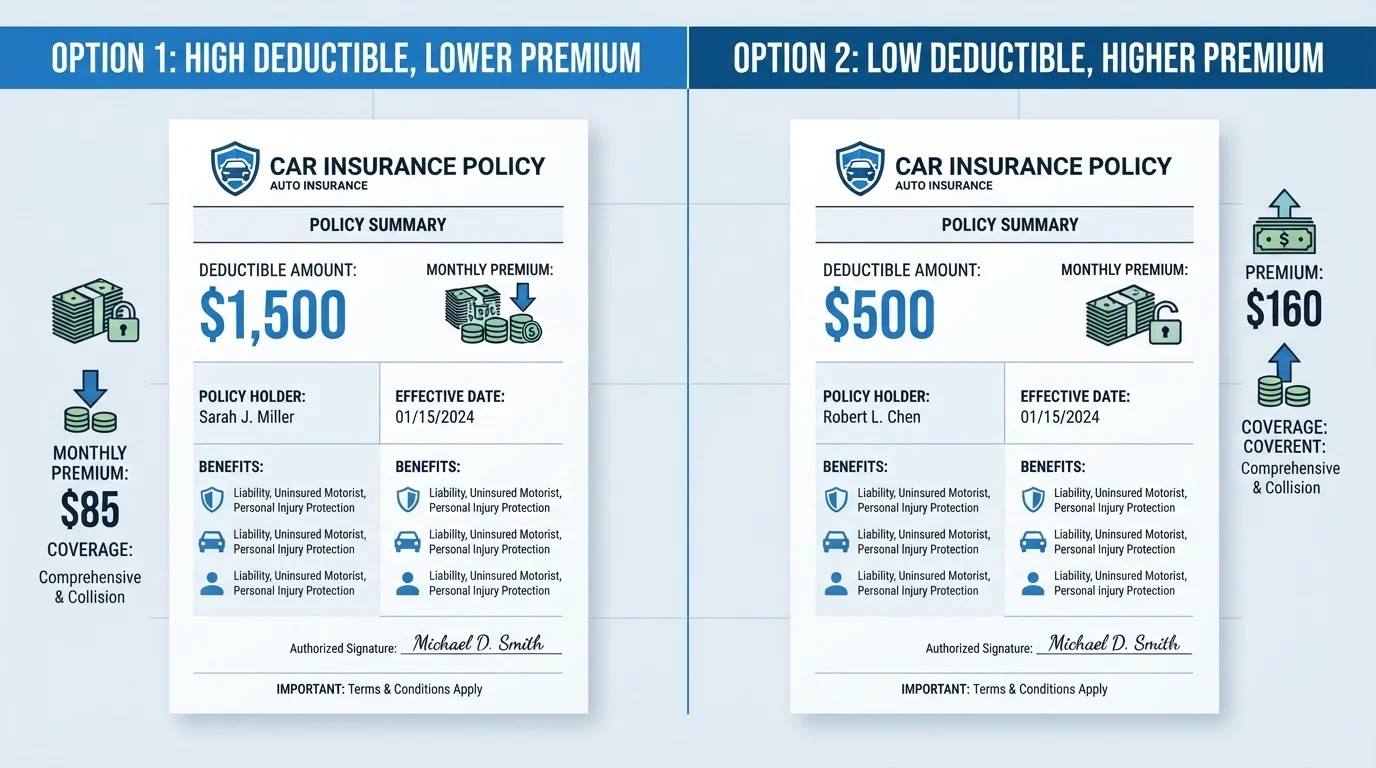
Your premium is the amount you pay - typically monthly or every six months - to keep your auto insurance policy active. Your deductible is the amount you agree to pay out of pocket when you file a claim before your insurer covers the rest. These two figures are inversely linked: choosing a higher deductible generally lowers your premium, and choosing a lower deductible generally raises it.
Deductibles apply per claim, not annually, and they are specific to certain coverage types - most commonly collision and comprehensive - not to liability coverage, which has no deductible.
How the Trade-Off Actually Works
When you buy an auto insurance policy, every coverage choice involves a deal between you and your insurer. One of the most consequential - and least understood - is the relationship between your deductible and your premium. These two numbers sit on opposite ends of a seesaw: move one up, and the other typically moves down.
The logic from the insurer's perspective is straightforward. A higher deductible means you absorb more of the cost when a claim occurs, so the insurer's exposure is smaller. Smaller exposure translates to a lower price for your coverage. Conversely, a low deductible shifts more risk onto the insurer, which charges more for taking it on.
For drivers, understanding this dynamic is essential before making any policy changes. The basics of how auto insurance works provide useful context, but the deductible-premium relationship is worth examining on its own because the math behind it isn't always intuitive.
~10-15%
Typical premium reduction from doubling your deductible
Industry estimates commonly cited by consumer insurance organizations suggest doubling a collision deductible from $500 to $1,000 may reduce that coverage's premium by roughly 10-15%, though results vary significantly by insurer and driver profile.
$500
Most common deductible chosen by U.S. drivers
According to insurance industry surveys, $500 remains the most frequently selected deductible level for collision coverage among American policyholders, representing a middle-ground between premium cost and out-of-pocket exposure.
Breaking Down When a Higher Deductible Makes Sense
Raising your deductible to lower your premium is only a winning move if you go long enough without filing a claim to offset the extra out-of-pocket cost when you do. This is what financial planners sometimes call a break-even calculation.
Here's how to think through it: if increasing your deductible from $500 to $1,000 saves you $150 per year in premiums, it would take roughly three and a half years of accident-free driving before you've saved enough to cover the additional $500 you'd owe in a claim. File a claim in year two, and you're worse off financially than if you'd kept the lower deductible.
A higher deductible tends to favor drivers who: have a long, clean driving history; rarely drive in high-risk conditions; can genuinely afford the out-of-pocket deductible amount without financial hardship; and have a vehicle that isn't financed (lenders often require lower deductibles on vehicles they hold liens on).
Run the Break-Even Math Before Changing Your Deductible
Ask your insurer for quotes at two or three deductible levels, then subtract the premiums to find your annual savings. Divide the difference in deductibles by those annual savings - that's how many years of claim-free driving you need before the higher deductible pays off. If that number feels too long given your driving situation, consider staying with a lower deductible.
It's also worth noting that the savings from raising your deductible taper off at the extremes. Going from $250 to $500 may produce meaningful premium relief; going from $1,500 to $2,000 often produces a smaller proportional reduction. The full picture of what drives quote differences includes far more than just deductible levels.
What Deductibles Don't Apply To
A common point of confusion is which parts of your policy actually have a deductible. The answer: not all of them.
Liability coverage - the portion of your policy that pays for bodily injury or property damage you cause to someone else - carries no deductible. If you're at fault in a collision and the other driver files a claim against your liability coverage, your insurer pays that claim without requiring any upfront contribution from you.
Deductibles apply specifically to collision coverage (damage to your vehicle from an accident, regardless of fault) and comprehensive coverage (damage from non-collision events like theft, hail, fire, or falling objects). Some policies also allow separate deductibles for each, so your collision deductible could differ from your comprehensive deductible.
Medical payments coverage and uninsured motorist coverage may or may not carry deductibles depending on your policy and state regulations. The auto insurance glossary is a reliable reference for clarifying these distinctions on your specific policy.
The Financial Risk of Choosing Wrong
The most underappreciated risk in this trade-off isn't overpaying on premiums - it's choosing a deductible you can't actually pay when a claim occurs.
If your deductible is $1,500 but you don't have $1,500 readily available after an accident, you may be unable to get your car repaired through insurance. That can mean driving an unsafe vehicle, missing work, or taking on high-interest debt to cover the gap. The premium savings become meaningless in that scenario.
A sound personal rule: your deductible should be an amount you could pay out of your existing savings without significant financial strain. It doesn't need to be painless, but it needs to be feasible. If $1,000 would genuinely put you in a difficult position, a lower deductible - even at a higher monthly premium - may be the more financially responsible choice.
Understanding why premiums vary so much between drivers also helps put deductible choices in context - your baseline premium may already reflect risk factors you can't easily change, making deductible adjustments one of the few levers you actually control.
This article is for general informational purposes only and does not constitute personalized insurance or financial advice. Coverage terms, deductible options, and premium calculations vary by insurer, policy, and state. Consult a licensed insurance agent or financial adviser for guidance specific to your situation.